Saturday, 20 June 2015

Walking in the footsteps of Incas

A trip to Peru wouldn't be complete without visiting Machu Picchu. There are different ways of getting to the site and one of the most popular is via the Camino del Inca. In order to be allowed on the trail you have to apply for a permit of which there are 500 available each day.

Due to the popularity of the trek you often need to apply several months beforehand to ensure you can get hold of one. Because the Inca trail was part of my tour, Tucan Travel organised everything I required for this. If you aren't able to get a permit there are alternative treks available, which will include a visit to Machu Picchu, three people on my tour did the Lares trek.

There were seven of us doing the Inca Trail and the day beforehand we were issued with our duffel bags, which would be carried by the porters and should weigh no more than five kilograms including the weight of the sleeping bag. We were also able to take day bags, which we would carry ourselves and could contain any excess items.

Bags all packed we were collected from our hotel by our guide Ruben, our cook Albino and our team of porters. For the seven of us we had a team of nine accompany us.

We drove the short drive from Ollantaytambo to KM 83 where the trail starts and it was here that the porters started packing their loads. The majority of our crew didn't appear to be much taller than me and the bags they were carrying were almost the same size as them. 

Due to regulations each porter is allowed to carry no more than 20kg and at various checkpoints their bags get weighed to check they aren't over their limit. Despite me packing light when my bag was weighed for the final time it was one kilo over so I ended up having to transfer a few things to my day pack.

The Inca Trail is 26 miles long and we would be walking it over the course of three days arriving at Machu Picchu on day four. The first day of walking was relatively easy with no big ascents or descents and we reached camp just as the rains came in.

The porters had already set up camp and after dumping our bags in the tents and having a quick rest we were called for afternoon tea in the dining tent. It was Liz's 60th birthday so we all chipped in a bit of extra money so the cook could get ingredients to make a cake. Given the limited cooking equipment we were all shocked when a fully iced sponge cake appeared and it was a great way to celebrate. The sponge had been steamed and was pretty tasty.

After tea came a three course dinner and we were all in bed by 7.30pm.

Ruben told us that day two is the hardest day due to the ascent up to Dead Woman's Pass and he wasn't wrong. Most of the trail is the original paving, which is a lot like a rocky track and tricky to walk on. What I also hadn't really banked on was how many stairs there were too.

The day started well and at our first rest stop Ruben said we were a fast group, so fast that Liz was already out of sight ahead of us. After this stop came the hardest part of the ascent and it wasn't so much physically exerting, but actually breathlessness caused by the altitude that caused the most problems. The last 100 metres to the top of the pass were tough especially as the steps in this section were also quite steep, but the view from the top made it worth the strain. 

We rested at the top for about 30 minutes before making our way down to the camp and if the way up wasn't too bad on the legs the way down was. Due to the unevenness of the path and steepness of the steps it was very slow going and I tried not to get too disheartened by all the porters whizzing down them with more than double the weight I was carrying and wearing sandals!

We noticed several of the porters all wore sandals and when we asked Ruben about this he explained that many choose to wear these as walking boots regardless of cost will wear out after three months of use.

After almost two hours of the downhill stairs I made it to camp and all of us were there ahead of the estimated time. It was a really sunny, hot day so it was nice to spend the afternoon relaxing and Catherine and I even had a quick dip in the river running through the campsite much to amusement of the porters. Once the sun went down it got really cold and that night it took me a while to get warm.

The next day was more of the same with lots of periods of downhill stairs. Unfortunately due to it being quite overcast we missed out on seeing our first glimpse of Machu Picchu in the distance. The vegetation on this part of the trail started changing and became slightly more tropical the more we descended. By the time we reached the camp I couldn't wait to get my boots off and give my feet some space to breath. So when at lunchtime Ruben told us there was a bit more walking to do to some ruins we thought he was joking.

The walk was only 10 minutes from the camp and it was worth it. Although there was a rather aggressive/amorous male llama wandering round so I tried to give him a wide berth. It was also while we were at this ruin that an American girl loudly announced she wanted a photo in front of the castle - there was no castle, but there was a cluster of what looked like houses!

This would be our last night with the porters as the following morning they had to leave at 4.30am in order to make it down the trail (in the dark) in time to catch the train to Ollantaytambo. If they miss the train they have to either walk the tracks or wait until the evening. This system is a bit of a contentious issue as the trail we would be following to Machu Picchu doesn't open until 5.30am, but the train company refuses to put on a later train in the morning for the porters.       

Many of the porters work four or six week back to back stints on the trail as it is more economically viable for them to do this before spending a few weeks back in their villages. What I also find sad is despite all of the hard work they do, none of them or very few of them will have ever been to Machu Picchu.

The next day we left camp at 4.30am and joined the queue of people waiting for the trail to open. At 5.30am the gate was opened and we made our way to the sun gate. The walk itself wasn't too bad, with the exception of a set of near vertical stairs to climb. The trail was the busiest we'd experienced during the whole trek because all the groups left at the same time. At the sun gate we had an amazing view of Machu Picchu below.

Forty-five minutes of walking later and we had made it, it was a strange feeling being somewhere I had seen so much in books and on TV and it all seemed a lot smaller, but no less incredible.

Thursday, 18 June 2015

Welcome to the jungle

From Puno we caught an eight hour bus to Cuzco where we would then fly to Puerto Maldonado, which is in the South East of Peru in the Amazon jungle.

It was a short 50 minute flight to Puerto Maldonado and after being at altitude in the highlands of Bolivia and Peru for almost a month it was nice to be back down almost at sea level again.

Most people visiting the town are going on to jungle lodges further down the Madre de Dios river, which is exactly what we did. From what I saw of Puerto Maldonado there isn't really that much there, which also became apparent on our quick tour of the town when the guide pointed out a water tower as something of interest!

We all piled in to a motor boat for the 1.5 hour trip downriver to the Eco Amazonia Lodge where we would be staying. This place has to be the closest I've been to staying in a resort and after months of hostels it felt quite fancy - there was even a swimming pool.

The rooms didn't have glass in the windows just mosquito netting so at night I could hear the sounds of the jungle, which was a lot louder than I thought it would be.

On our first day we went on a trek and as it was coming to the end of the main rainy season we wore wellies as the trail was very muddy. I don't know what has happened to my feet as I'm usually a size three or four but I ended up having to wear a size 1.5 on one foot and a two on the other!

We walked until we reached a clearing called 'Caiman Lagoon', we could just see the head of an adult female and lots of juveniles in the water, it was great being able to observe them in the water.

When the guide of another group arrived he had a bag of chicken, which he proceeded to chop up with a machete on the side of the bank to get the animals out of the water. He only just managed to get to safe ground when the mother appeared. I don't particularly like this method to entice the animals just for our benefit and would have been perfectly happy just seeing them as they were in the water.

The walk back to the lodge was particularly humid and oppressive so I took the opportunity to cool off in the pool, which by all accounts was pretty cold but fine if you kept moving.

Overnight and into the morning it rained quite heavily. We were due to go on another jungle walk, which got pushed back an hour in the hope it would ease, to no avail. In the end only six out of our group of 11 went. I'm glad I chose to because once we were under the main jungle canopy we were fairly well sheltered from the rain.

Despite the weather we still saw some wildlife including a huge snail and fire ants, which will give you a nasty nip if you get too close. We also saw and smelt several garlic trees and the bark is often used to add flavour in cooking. We finished up at a lagoon where we went out in a canoe and did some birdwatching..  

Back at the lodge and after a quick hammock siesta it was back on the boat across to monkey island, which is home to spider monkeys and capuchins. We were lucky enough to see both kinds and I loved watching them climbing and jumping through the treetops.

Monday, 1 June 2015

Island hopping on Lake Titicaca

Before I left the UK I decided to book an organised tour for some of the Peru leg of my trip for ease and to take some of the pressure off organising the various permits for the Inca Trek. After a lot of searching I finally decided to book the Andean Experience a 21 day trip organised by Tucan Travel as the itinerary covered pretty much everything I wanted to see.

As a solo traveller one of the things I liked about Tucan was that it didn't charge a single supplement unless you specified you wanted your own room. Having grown accustomed to sharing rooms by now I was happy to share on the tour too.

I met the tour leader, Neil and fellow travelling companions in La Paz. The group had already been travelling together for two weeks when I joined along with Becky and Hugh from Ireland. I was a little nervous especially breaking into an already well established group but everyone was very friendly and welcoming.

From La Paz we headed to Puno in Peru. The journey took around six hours including a minor drama when we had to swap buses in Copacabana because the one we were on wouldn't start. After overnighting in Puno we headed down to the docks to join the boat for our two day trip visiting islands on Lake Titicaca, which is the highest navigable lake in the world at 3,812m. As we would be staying overnight with a family we stopped off quickly to pick up food and toys to give to our host family as a thank you.

Our first port of call was the Uros Islands or floating islands. The people living on these islands create them by lashing together reed root clusters and then layering dried reeds on the top. Their houses are then positioned on top. Every few months more reeds are added to the top of the island.

If there are disputes on the island or if a family isn't pulling their weight they can be cut off, quite literally from the island. Similarly two islands can join together if they want to. 

From there we made our way to Amantani Island, which is where we would spend the night, our guide enjoyed telling us a bit about the courtship rituals on the island. Thanks to advances in technology this now involves the boys sitting on hillsides with a big boombox blaring out romantic music in the hope the object of his affections comes to join him. 

When we reached the island we were introduced to our 'mama' and taken to where we would be staying. I was staying with Terri, Catherine and Neil. The house was basic but cosy and the rooms were comfortable.

After a filling lunch of soup, potatoes, cheese and salad we headed out to the island's football pitch, where some of the group played a match against the locals. We then went on a hike up to the top of the island where we could see the Bolivian side of the lake in the distance. Despite the rather threatening looking grey clouds the views were amazing.

After the hike it was back to our various houses for supper and then we got dressed up in the traditional dress of the island for a fiesta. The men wore ponchos and the women had to wear an embroidered blouse, skirt, belt and shawl. Typically, the skirt I had was quite big and during the course of the evening I had to get my mama to help dress me again before it fell down. 

The fiesta was great fun with traditional music and dancing, which we all joined in with.

From Amantani Island we made our way back to Puno, stopping at Taquile Island on the way. On this island only the men are allowed to knit and the women weave. Before a man can have permission to marry he has to knit a hat, which his prospective parents-in-law fill with water, if the majority of the water is still in the hat after eight minutes then the man is given permission as it shows he is a good knitter.

While we were on the island we visited a cooperative, which sells various knitted and woven goods made by people on the island. I needed a woolly hat after losing the one I brought with me so took the opportunity to get one from the cooperative for 30 Soles. I was able to find out who made my hat and it had been knitted by a chap called Bernardo Flores.

Lunch was at a small restaurant on the island and the two options were either trout or omelette. The trout, which is from the lake, was delicious and cooked perfectly.

Back in Puno a few of us sampled the nightlife and ended up in a Mega Disco. When we walked in it was like we'd crashed a work night out as everyone was dressed in shirts and ties. The club had a lift as it was split over three levels but unfortunately only the ground floor was open so we weren't able to test it out. Definitely worth a visit if you ever happen to be in Puno.

Monday, 25 May 2015

Dicing with the Death Road

Returning from Sucre I booked a ticket with El Dorado again as the journey and bus there were good. My ticket for a full cama bus leaving at 7.30pm cost 180 Bolivianos.

The bus looked a bit older than the last one but the inside was nice and the seats really comfy, although I had a dodgy one that didn’t want to lock into place. The first couple of hours went by well and I enjoyed looking out the window at the stars and full moon. However, after stopping in Potosi at about 10.30pm I noticed the heating wasn’t on anymore. I covered myself with my llama jacket and waterproof and hoped it’d come back on. I was wrong and the next nine hours were spent in a half sleep absolutely freezing it was awful.

At 7.30am we stopped just outside of Viacha and I was greeted by the sight of an old man evacuating his bowels in a field opposite. Fifteen minutes later and we still hadn’t moved, at first I thought it was due to heavy traffic, however it was some sort of strike/protest.
 
I stayed on the bus along with most of the other passengers until the steward, who I later found out from another passenger was drunk for most of the journey and ignored people asking for the heating to be put back on, came on the bus and told us all to get off because the road could be blocked all day.

He said we should walk past where the road block was and from there we should be able to get a taxi. Faced with no other option myself and the seven other foreigners on the bus teamed together and started to walk. It wasn’t long before we found a taxi willing to drive us to the La Paz bus terminal for 190 Bolivianos. The eight of us and our luggage squeezed into the six seater car.

To get around the road block we had to drive on a track next to the road and through a village. About three miles down the road was another bigger blockade and we had to do some more off-roading including manoeuvring around barrels and a large fire. The road from here was clear until we hit the outskirts of El Alto and it was chaos with people all over the main road. We took to the backstreets, which quickly got clogged and it took us about an hour to get back on the Autopista. From here it was plain sailing and we got to the bus terminal without any problems. The 21 mile journey, which should take 40 minutes, took us 2.5 hours.

At the bus terminal I got another taxi to Villa Fatima so I could get a bus to Coroico. It cost 25 Bolivianos. At the bus station in Villa Fatima I got a ticket for 20 Bolivianos. This is where I made the mistake of not asking if it was all on the new road.

The journey went well and as we climbed out of La Paz it felt like we were up in the clouds. I then saw a turn off for the notorious Ruta del Muerte (Death Road) and was surprised when I noticed the bus slowed down and turned off to go down the road. Many tour operators in La Paz run mountain bike excursions on the road and this was not something that really interested me when I was there so I was even less keen to experience it in a bus.

As soon as I realised there would be no turning back the panic inside started to rise and I realised that I was totally at the mercy of the driver. Any mistake by him could result in us tumbling over the side. It also didn’t help that I was on the window side of the bus closest to the edge.
 
As we rounded some bends you could see how much of the road had just eroded away leaving a sheer drop, there were also precarious sections when we had to cross under waterfalls. Needless to say I did not enjoy the journey and being sleep deprived and hungry all added to my general feeling of dread. Thankfully we made it and re-joined the new road. When I wasn’t being scared I tried to appreciate the views, which were stunning.

I stayed at Hostel Chawi in Coroico, the hostel is set in stunning gardens and if it had been better weather I definitely would have made more use of the sun terrace overlooking the valley. I was the only person staying at the hostel so I had the eight bed dorm to myself.

Despite only being 70 miles from La Paz the climate in Coroico is almost tropical due to the town only being 1,200 metres above sea level. The town is very pleasant and provides some much needed respite from the chaos of La Paz. There are some nice walks around Coroico and during my stay I went on several wanders into the valley.

I also took the opportunity to get my hair cut and selected a small hairdressers on one of the streets leading up from the main square. I only wanted to get my undercut redone and after a bit of sign language and mixture of Spanish and English, I entrusted the barber with my barnet. He did a really good job and all for just 10 Bolivianos.

After my nail biting journey to Coroico I made sure when I left to ask which route the driver would take. When I was told it would be the old road my heart sank and after establishing that no vehicle would be taking the new road I resigned myself to the fact that it was my only option and I would have to brave it again. I later found out that there had been a landslide on the new road hence why the old road was being used.
 
I felt a little happier as the vehicle was smaller than the bus before, but it was a bit unnerving when the two people next to me crossed themselves as we got on the road.

During the journey I found myself with a newfound respect for the drivers who have to use the road every day especially when there were tourists on bikes hurtling past us often in the middle of the road. I can understand how accidents do happen and I suspect some of it must be down to the number of inexperienced people using that route. Thankfully both my dalliances on the road ended well and I have no desire to ever go on it again.

Saturday, 23 May 2015

A Tale of Two Cities


After I finished my volunteering I headed south to the city of Sucre. The city has had many names including Charcas, La Plata and Chuquisaca. It is a UNESCO Heritage site because of the Spanish colonial architecture in the city.

From La Paz I travelled to Sucre by bus with the company El Dorado. My ticket cost 180 Bolivianos for a full cama seat. The bus was at 7.30pm and had it not been more than 30 minutes late I would have missed it because I seriously underestimated how bad traffic is in La Paz during rush hour.

I ended up hopping off the colectivo I was on and running up the main street to the bus station, which is up a steep hill. I got there at 7.40pm and wheezing like an old woman, who smokes 40 a day (I was still recovering from a cold), I went straight to the bus company desk and asked if the bus had left. I thought the woman said yes but she handed me back my ticket and told me which stand to go to. The bus eventually showed up and it was very comfortable and even warm for the majority of the 13 hour journey.

Also, worth noting here is that when you leave La Paz by bus you have to pay a 3 Boliviano departure tax, you won’t be allowed out to the bus without a ticket to prove you’ve paid. There is a small kiosk where you can pay this in the terminal.

I arrived in Sucre just after 9am and got a taxi for 10 Bolivianos from the bus station to Kultur Berlin hostel. This hostel is worth staying at for the breakfast alone. Hands down it is one of the best breakfasts I’ve had during my travels so far. There was freshly squeezed fruit juice everyday, a range of fresh fruit, cereal, many different types of fresh bread and rolls and there were even pancakes on one occasion. The nine bed dorm I was in had loads of space, comfy beds, a high ceiling, nice bathroom with a really hot shower, wooden floors and all for 55 Bolivianos.


I’d arrived on a public holiday so not a lot was open, however I did end up stumbling upon a parade in the main square. From what I could gather the parade consisted of groups from various villages/towns around Sucre. Each group had dancing cholitas, followed by the men, followed by a full brass band. It was really interesting to watch and it seemed some groups were more into it than others.

My first impression of Sucre was that it seemed like I wasn’t in Bolivia any more due to the colonial Spanish architecture, it was very weird. It is a beautiful city and wandering round you would be forgiven for thinking you were somewhere in the Med due to the whitewashed buildings and bright blue sky.
 
It is a great place to just wander and see what you find. In the city itself the Plaza 5 de Mayo is very impressive. The Mercado Central on Junin street is also worth a visit, although I went in for two apples and came out with two pears, two apples and a mango due to the stallholder being very persuasive.
 
From the Mercado stroll to Calle Destacamento where the theatre is and then on to Parque Simon de Bolivar where you’ll find a replica of the Eiffel Tower and shady spots to sit. On the other side of the park is the train station and the psychiatric hospital, which was the first in Bolivia.

Heading uphill from Plaza 5 de Mayo is a mirador, where you have a great view across the city and somewhere to recover from the steep uphill walk. I also visited the textile museum, which has information on the different textiles and weaving methods in the region. There were some exquisite examples on display.


One of my main reasons for visiting Sucre was to go to the Sunday market in the nearby village of Tarabuco. Before going I read many conflicting views on whether it was going to be worth it, being someone who would rather go and see for myself I remained undeterred and bought a bus ticket from one of the tourist agencies in town for 40 Bolivianos.

The bus left at 8.30am on Sunday from outside the cathedral and we arrived in Tarabuco just after 10.30am. It was a short walk to the main square, which was a hive of activity with lots of textile sellers set up.

I wandered down one of the streets off the square and found the main market, which was like El Alto on a smaller scale, however the streets were jam packed with people moving in all directions. One of the most popular stalls seemed to be the DVD one with many children crowded round watching the television. I managed to make my way out of the scrum to the main food market, which then seemed to lead into a more wholesale affair with vendors selling oranges off of lorries etc.

I also spent a lot of time just sitting in the main plaza people watching. There seemed to be an equal mix of tourists and locals. I even treated myself to some homemade ice cream for 3 Bolivianos. I’m glad I went to the market, there isn’t really anything there you can’t find in La Paz, but I enjoyed the atmosphere.

While I was in Sucre I went to Potosi, another UNESCO heritage site and one of the highest cities in the world at 4,060m. I decided to just go for a day. The city was once the largest and wealthiest in Latin America due to silver deposits being found in the Cerro Rico mountain, which looms above the city. Today, although much of the silver has been depleted, miners continue to work in harsh conditions in order to extract what remains.

One of the main draws for tourists visiting Potosi is to take a trip down the mine. However, as I'm asthmatic, was recovering from a cold and had been advised by a miner friend of mine not to, a visit to the mine was not something I wanted to experience.
 
I understand why people do choose to visit it, but the other reason I wasn’t keen was because for me it all feels a bit weird. It’s not a museum, it’s a working mine and I just didn't like the idea of going.

There are almost hourly departures to Potosi from Sucre, so I bought my ticket on the day for 20 Bolivianos with the company Trans Emperador. The journey was perfectly pleasant except for when we were on the outskirts of Potosi and crossing train tracks. While we were halfway across I heard a horn and was surprised to see a train bearing down on us, thankfully it was going so slowly we were able to get out of the way.

Potosi’s bus station is possibly one of the nicest I’ve been in, it is a new building and is circular with a very elaborate marble staircase leading to the entrance. I ended up going to Potosi on a bit of a whim as originally I hadn’t planned to go, so it also probably wasn’t the best idea to go without knowing where the main centre was or that the bus station is quite a way out of the city.

I assumed I’d be able to get a taxi from the bus terminal and ask to go to the centre however, when I arrived all the taxis were the unregulated kind and I didn't want to take any chances. In the end I hopped on a mini bus bound for the Mercado Central, which I hoped was in the centre, my gamble paid off and I got there without any issue.

Similar to Sucre the city has some amazing colonial architecture and I just enjoyed wandering around the narrow streets looking at all the different buildings. The colourful Cerro Rico dominates on the horizon and it is strangely hypnotising.
 
I decided to take a mini bus back to the bus station and hopped on one I thought was going in the right direction only to discover I had made a mistake when the bus reached its last stop. I ended up in some residential area on a hill overlooking the bus station, I explained to the driver (in Spanish) where I had wanted to go and he started laughing pointing to the bus station below us.
 
View from the bus station to the top of the hill where the bus terminated
He told me that his bus went to ex-terminal, which is the old bus station. When I told him my bus was leaving in 30 minutes he advised me to hop on one of the buses going back the way we'd come He also explained my predicament to the other driver and asked him to let me know where to get off so I could get the correct bus. I couldn't believe how helpful the drivers were and was very grateful. I managed to hop on another bus going the correct way and made it to the terminal in time for my bus back to Sucre. 


Wednesday, 13 May 2015

Getting Up Close to Bolivia


Before I left the UK I had toyed with the idea of setting up some volunteering but not knowing exactly where I would be and if I would be able to commit to the minimum amount of time some organisations expect you to stay made things tricky.

While I was in Chile I realised I would have time in Bolivia. After emailing a few organisations but to no avail I had almost given up on the idea. Tas and Kris the couple I met on my second Pachamama tour suggested I try contacting Up Close Bolivia as they were planning to volunteer with them for a month.

I checked out the website and was impressed with the range of projects volunteers can work on, so to cut a long story short I was accepted and arranged to do a two week stint.
 
Up Close Bolivia works on the concept of ‘reciprocidad’, which is at the heart of Andean culture. It is all about giving back and contributing in a way that enriches the person giving and the person receiving. It was this aspect that really appealed to me.

The family-run enterprise was set up by Emma, an ex-volunteer from England, and her Bolivian husband Rolando. For the last 10 years they have welcomed volunteers and visitors and are committed to helping develop sustainable, community-led development projects and environmentally-friendly tourism that benefits their community.

I had been in La Paz a few days before my placement was due to start to acclimatise and get my bearings. I would be living in Jupapina, a small village just south of La Paz, for the duration and my first mission was to get there. I considered getting a colectivo but was unsure if the driver would take me and all my baggage. Instead I plumped for the easy option and booked a taxi.

 I stayed in the house on the left
I arrived at Emma and Rolando’s home, the volunteer accommodation is based in the grounds of the house and was greeted by Rolando, who took me to my digs, which I would be sharing with Tas and Kris. After almost three months on the road it was weird to have a room to myself and also know that I would be in one place for more than a couple of nights – I could actually unpack!
 
I had a welcome session with Anahi, who is a coordinator for Up Close Bolivia. She took me through my schedule for the next 14 days and explained a little more about the projects I would be helping in. I was also given a tour of the village, the centre of which is just along one main road and got to meet some of the shopkeepers.

Jupapina is beautiful and is surrounded by mountains. I certainly liked being out of city and back in the countryside. One similarity I noticed between here and the village I grew up in is how friendly everyone is and when you pass someone on the street you’ll say hello to each other.
 
My first task as a volunteer was to help paint a mural in the new square, Plaza de las Niñas, in the village. I’m no artist so I left the drawing to other more capable people and I just coloured in. However, I did get to draw some stick men! We just about managed to finish the mural in time for the official opening ceremony.


I also got to work at Fundacion Porvenir, which is an equine therapy centre, just down the road into the valley in Jupapina. The centre provides free therapy to children with physical and mental disabilities.
 
I was a bit apprehensive about helping here because I don’t particularly like horses and am a bit scared of them. However, the role of the volunteer here is to play with the children before they ride the horse and assist where needed when they are on the horse.
 
During my first session I was thrown into the deep end when Humberto, who runs the foundation, asked me to hold onto the lead of one of the horses. Up until this point the horse had been very well behaved, but as soon as it was in my control it somehow managed to unclip itself from the lead. Thankfully it decided not to go galloping off into the sunset and I was able to hand over the reins as it were to one of the other more experienced handlers.
 
As I can speak a bit of Spanish I was able to play games with the children while they were on the horses, such as holding up flashcards of colours or numbers and getting them to tell me what each was.

I enjoyed my time helping and although I was only there for six sessions I got to know the parents and children as well as see the difference the therapy has on their lives. Many of the children have to make long journeys just to get to Jupapina. Haydn, one of the other volunteers created a film about the work of the foundation and it can be seen here.
 
As well as this, I was placed in a children’s centre in Mallasa, the next town on from Jupapina. It is a community run centre for local children, many from poor backgrounds, aged six months to four-years-old.

I helped in Tia Lucy’s class with the babies, who were all very cute. My help here usually involved supporting Lucy by cleaning up after the breakfast and lunch, wiping noses, playing with the children and often having to move the ones who had strayed from the mat back onto it.
 
Mallasa is also a great place for getting chicken that has been roasted over a wood burning fire. For 15 Bolivianos you can get a piece of chicken, rice, roast potatoes and roasted plantain. The chicken cooked this way has been some of the best I’ve had, the skin goes really crispy and the meat underneath is beautifully moist.
 
The last project I was able to help in was the zoo, which is situated just outside Mallasa. The zoo mainly houses animals, which have been trafficked or mistreated so all except for the lions are indigenous to Bolivia. The lions were rescued from a circus as animals are not allowed to perform in circuses in Bolivia.
 
My job as volunteer was to help Emerson, who comes up with inventive ways to keep the animals entertained and stimulated. At the zoo we had to wear a fetching beige jumpsuit, being only 5ft I knew that the chances of mine fitting would be slim. However, after signing in I was allowed to have a special jumpsuit suitable for pint sized people. I’m still fairly certain it was one for children!

During my sessions at the zoo I helped lift turf to replant in the tortoise enclosure, I really enjoyed this as we got to go in the enclosure and one of the tortoises was very curious and kept coming up to me. I also helped create boxes out of egg trays and then covered them in llama wool. The boxes were filled with various entrails from a donkey and we got to hang them up in the puma enclosure. When the pumas were released we got to watch them grab the boxes and eat the contents.
 
In addition to the volunteering, I also took the opportunity to improve my Spanish by having 10 hours of intensive one to one lessons for 850 Bolivianos. Anahi organised everything for me and my teacher was Sonia. She was lovely and by our last session I was feeling more confident with my speaking, which is the area I was having most frustration with as I found I usually understood what people said to me but often didn’t have the vocab to respond.
 
Overall I really enjoyed my experience with Up Close Bolivia and even though in two weeks it felt like I’d barely scratched the surface it gave me a great insight into Bolivian culture as well as some of the struggles. Emma, Rolando, Anahi and the other volunteers were great and so helpful they really made me feel like part of the family.

Despite the times when it felt like Bolivia was trying to break me (there were instances when my bowels didn’t know whether they were coming or going and I managed to catch one of the worst colds I’ve had in about five years) I would definitely like to return, but for longer next time.


Saturday, 9 May 2015

Living the high life

 
I travelled to La Paz on the 9am Cali Intentional bus from Arica. The ticket for this trip cost 10,000 pesos.

The journey to La Paz takes around eight hours and lunch was included in my ticket. During the journey immigration forms were handed out so I filled mine in, by now I don’t even need to check my passport number as I’ve written it so many times.
 
Just as I was about to put my pen away the woman opposite motioned to me, I thought she wanted to borrow the pen, but I was wrong she actually wanted me to fill out her forms for her and thrust them and her ID card at me. Filling out a form for myself is hard enough sometimes but to do it for someone else, who doesn’t speak the same language is a different kettle of fish.
 
I managed to complete most of the form using the info on the ID card, however there were some questions I wasn’t able to answer so I had to ask. What I hadn’t prepared myself for was not being able to understand the response, which happened a couple of times so I just wrote what I thought I heard and then got her to sign it.

We stopped at the Chile border post first to get stamped out then a bit further down the road we stopped at the Bolivian post. It was very quick and easy although I did have a moment when I realised the woman I helped hadn’t come back. Thankfully she did re-emerge - phew!
 
La Paz is the highest capital city in the world at 3,700 metres, having spent a week at sea level I’d resigned myself to the fact I’d probably have to go through the acclimatisation process all over again.
 
When the bus pulled into the bus station I was prepared for the usual chaos but it was surprisingly quiet, then I remembered it was Sunday. I walked from the bus station to Muzungu Hostel on Calle Illampu it took about 20 minutes. The walk was absolutely fine aside from the last five minutes, which were uphill and I really noticed the lack of oxygen. It didn’t help that my hostel was also up a set of stairs but thankfully my room was on the first floor.
 
Up until this point I’d been ok aside from a sore throat, which I’d been harbouring since Arica. However, as soon as I started unpacking the altitude hit me and my head was pounding. A lovely Swiss girl in the dorm let me have a sweet to help with it.

The next day I was feeling better and walked up the four flights of stairs to the breakfast room, which had amazing views across the city, by the time I reached the top I was ready for a sit down as I was breathing pretty heavily and probably could have given Darth Vader a run for his money.
 
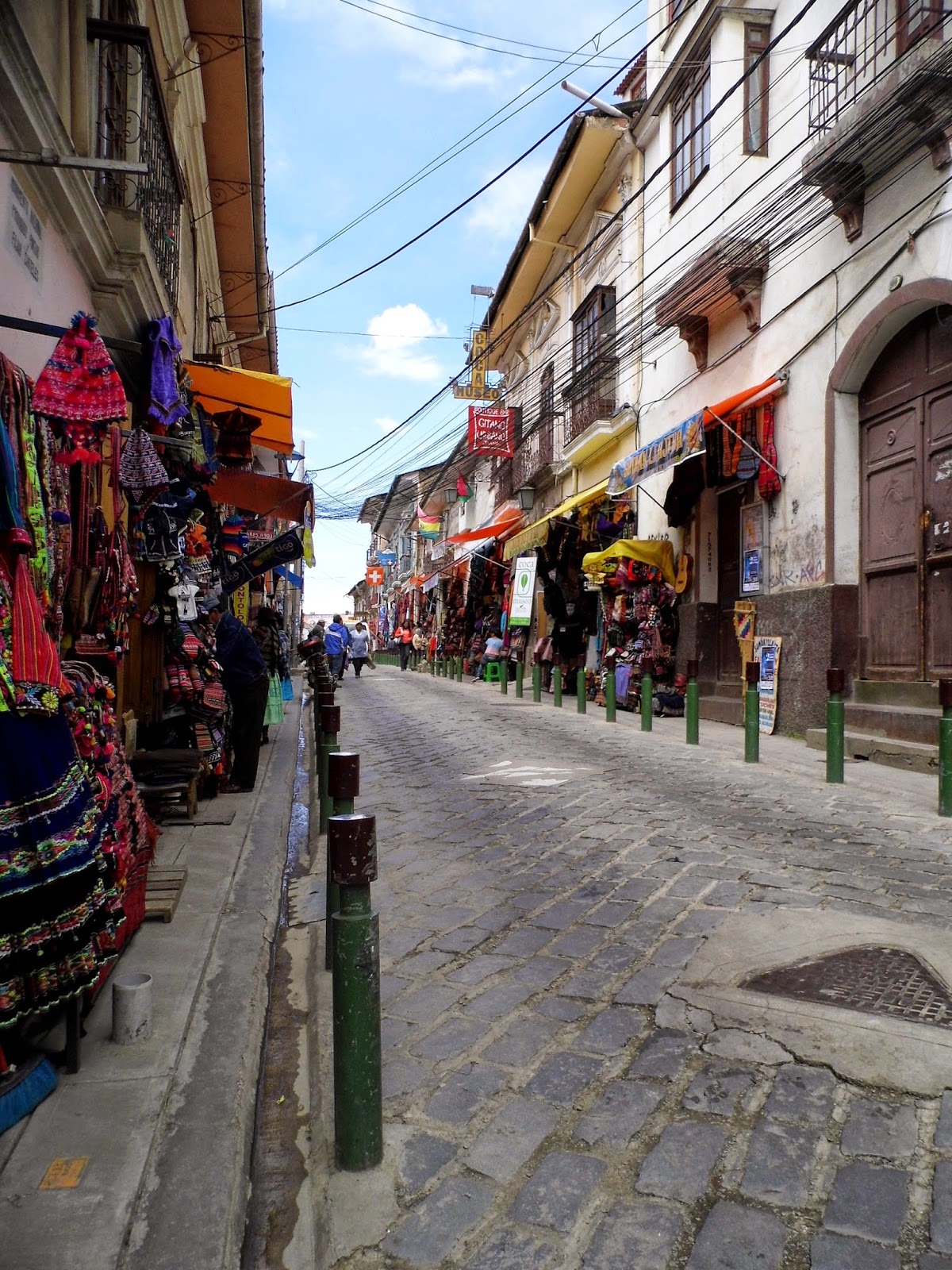
The hostel is in the heart of the main tourist area where there are lots of shops all selling various fabrics, jumpers made from llama wool, handbags etc. I did have to restrain myself as it is very easy to get carried away.  I was also staying close to the Witches Market, where you can pick up various herbal remedies, talisman, charms and llama foetuses! The latter are used when building a new home and are buried in the foundations as a gift to Pachamama. I found it fascinating just wandering around looking at everything.
 
One of the main things I noticed in the city was the pollution in the streets from exhaust fumes, sometimes it was overwhelming. I also felt like I was taking my life into my own hands every time I crossed the road. I’ve been to Vietnam where it is pretty crazy but at least you know the traffic will move around you, here I was not so sure. The amount of times I saw a bumper just out the corner of my eye barely millimetres away from me and still moving.
 
While I was in La Paz I decided to try out the free walking tour by Red Cap Walking Tours. The tour meets in Plaza San Pedro every day at 11am. I got there a 10 minutes and early and kept an eye out for someone in a red cap but didn’t see anyone. Then I was approached by a guy in pretty normal clothes who asked if I was waiting for the tour. I said I was and he said he was the guide and it would start in a few minutes. Alarm bells started ringing and concerned he may not be a real guide I decided to see if anyone else turned up – power in numbers and all that. Soon enough there was quite a crowd of us so I decided to take a chance.
 
Outside San Pedro Prison
The tour started and what I hadn’t realised up until this point was the building on one side of the square is the notorious San Pedro Prison where a lot of drug traffickers, dealers, gang members and other criminals are imprisoned. The prison is like a city within a city. There are no guards inside the main prison and up until a few years ago prisoners’ families were able to live with them there. As with most things if you have money you can live quite comfortably and I have read that the most well off inmates have three storey properties with the more lavish including hot tubs!
 
The tour covered the area by my hostel so I was already fairly familiar with this part. By this point a lot of people had trailed off and left. We finished in Plaza Murillo, which is where the main governmental buildings are. I gave the guide a small tip as he hadn’t been as good as the guide in Buenos Aires and I was still sceptical. I looked up the Red Cap website when I got back and discovered they currently aren’t running free walking tours at the moment so it would seem the guy wasn’t legit after all.
 
Having had enough of the touristy part of town I wandered around Calle Rodriguez where there is a big fruit and veg market everyday and I also walked around the streets around Mercado Negro where you can buy pretty much anything. I walked down one street, which just had a lot of stalls all selling lightbulbs, then another hardware items etc.
 
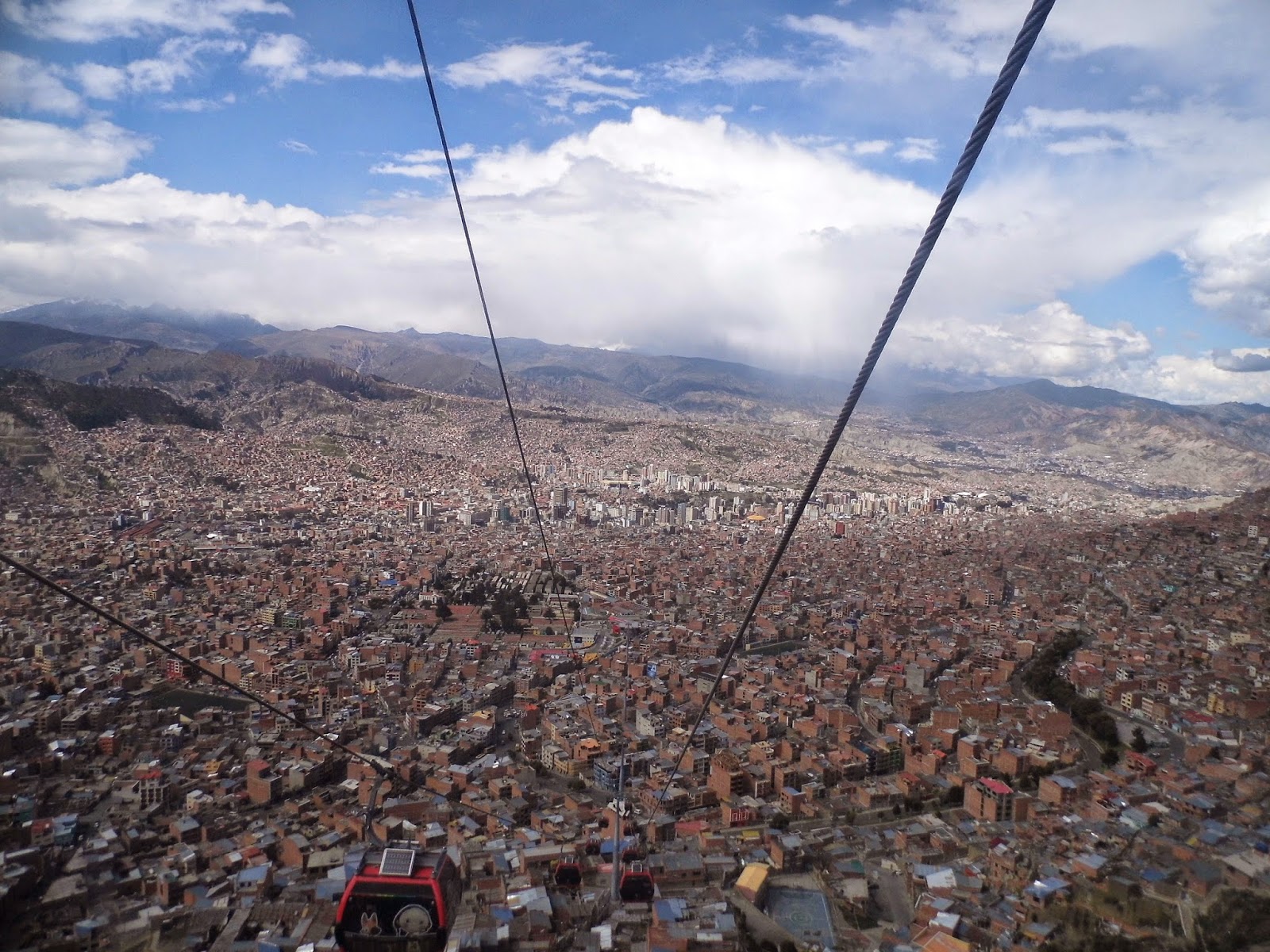
Every Thursday and Sunday there is a big market in El Alto, which is a suburb at one of the highest points of La Paz, 4,150m and is a mini city in itself. To get to the right part of El Alto I took the teleferico (cable car), La Paz is one of the only cities in the world, which uses cable cars primarily as a form of public transport. There are three lines in the city with another three due to be opened this year. To get to the market you need to take the red line from Estacion Central to 16 de Julio. The journey costs three bolivianos and the views alone make it worth the trip.
 
Once at the top you step out from the station into the market. Being a Thursday it was busy but probably not as crowded as a Sunday, which was good. Pickpocketing is known to happen in the market so I kept a firm hand on my bag just in case. I wandered around and again this market had all sorts of products on sale from every kind of car part imaginable to a road just selling timber and other DIY type products. There were also rows of stalls piled high with clothes to rummage through and I ended up coming away with a couple of things for 20 Bolivianos.

There were, as I had hoped, stalls selling the colourful aguayo fabric, which is traditionally used by women to carry babies, food, market produce and anything else they might need on their backs. I loved the fabric and knowing what the prices were in the tourist market I wanted to see if I could get it cheaper here and I did. I came away with a large piece for 50 Bolivianos about half what I’d been quoted in the tourist shops.
 
On my last day in La Paz I visited the Coca Museum on Calle Linares, which tells the history of the leaf along with its links to cocaine. It was really interesting although if you don’t like reading I would give it a miss as there was a lot to take in. In the museum is also a café selling a range of coca products and I tried a coca hot chocolate and a coca cookie. Both were really nice although the drink was a little gritty towards the end.
 
La Paz is a very vibrant city and it is great for people watching. I particularly enjoyed just watching the cholitas go about their business. Cholitas are Aymara Indian women who wear traditional dress, which consists of a bowler hat, patterned shawl, blouse, a pollera (a very voluminous pleated skirt reaching the ankles) and flat shoes with a rounded toe. In the 16th century this style of dress was introduced by the Spanish, who forced the indigenous population to wear the typical European clothing of the era. Today, women continue to wear the typcial clothing daily in both rural and urban areas.
 
In the more touristy areas it can be difficult to find food that doesn’t cost similar to that back in the UK, however one of my top tips especially if you just want a quick snack is to go to Mercado Lanza, which is just off Plaza Mayor in the centre. On the top floor of the market are row upon row of small cafés. The cafés contain a small table and bench. On the other side of the table is the kitchen, where place your order.
 
On one occasion I went with three other people and three hot drinks and two fried egg rolls cost less than £1! Alternatively, there are some really great local eateries tucked away on the main streets and they often have a menu del dia – two courses for a set price. I discovered an amazing veggie restaurant on Calle Murillo and had the set menu for the equivalent of £1.50. The place was also packed with locals.

I spent four days in La Paz and this was more than enough to see the main sites and get a flavour for the city.