Showing posts with label Argentina. Show all posts

Monday, 27 April 2015

Shake, rattle and rolling my way to Salta

Before getting to Uyuni I had read a bit about getting to Salta in Argentina. As Bolivian buses aren’t allowed across the border I would have to cross on foot at a town called Villazon and pick up a connecting bus in La Quiaca to Salta.

It was recommended to take the bus to Villazon during the day due to the condition of the road. My first task when getting to Uyuni was to sort out my bus and then find somewhere to sleep. There is no main bus terminal in Uyuni, however all the bus company offices are situated around the top end of Avenida Arce (after the plaza with the church), Cabrera and Peru. The buses pick you up from outside the office you booked with. After trying two companies, which only had evening departures, I found one, Tupiza Travel, that had a bus leaving at 6am the following day for 60 Bolivianos.

Due to the early start I endeavoured to find a hostel close to the bus company’s office. After passing a few dubious looking places I stumbled upon a fairly modern looking hotel about a 2 minute walk from where I’d have to get the bus.

As I usually try to book ahead I didn’t have much practice with regards asking in Spanish for a room so I turned to the limited phrase section of my guidebook to help. In my rush I accidently turned to the Portuguese section, realised what I was saying didn’t seem right and noticed the owner was looking at me slightly bemused before I found the right page and managed to get a single room for 60 Bolivianos. The room was basic and the bed was clean and comfy so for one night it was fine.

I was told to get to the office 30mins before departure so that meant another 5am start. When I walked into the office I was unsurprisingly the only gringo so this alone got me a few looks. Some of the people waiting looked like they may have been there all night as several were asleep in the uncomfortable looking plastic garden chairs under blankets.  

The bus arrived and it wasn't as bad as I thought it might be but it still looked like it had seen better days. The first three hours of the journey were over unpaved road so it was very shaky. This coach also had sliding windows and typically I was sat next to the one with a dodgy catch so every so often the vibrations caused it to open!
 
Waiting in Atocha
We made a few stops in tiny hamlets and picked up a few people before making a stop in a village called Atocha. I overheard the driver say we’d stop for an hour, so I took the opportunity to stretch my legs a bit and people watch. Ended up chatting to a young girl, who also got on in Uyuni and I shared some chocolate with her.
 
Then an old-ish guy, who also got on at Uyuni approached us. He asked how I was getting on with the altitude, at first I thought he was saying I had a red nose from the sun (admittedly I did a bit) but he was actually referring to breathing. He explained he comes from the Santa Cruz province, which is in the lowlands and was finding he was short of breath here. He was very animated when he spoke along with lots of gesturing so I didn’t find it too hard to get the gist of what he was saying and found him quite amusing.

The village, which had been fairly sleepy up to this point, suddenly filled with people, I still have no idea where they all came from, wanting to get on the bus. By the time we set off again there were lots of people standing in the aisle, which I think may be illegal in Bolivia as overcrowded buses are often a main cause of accidents.
 
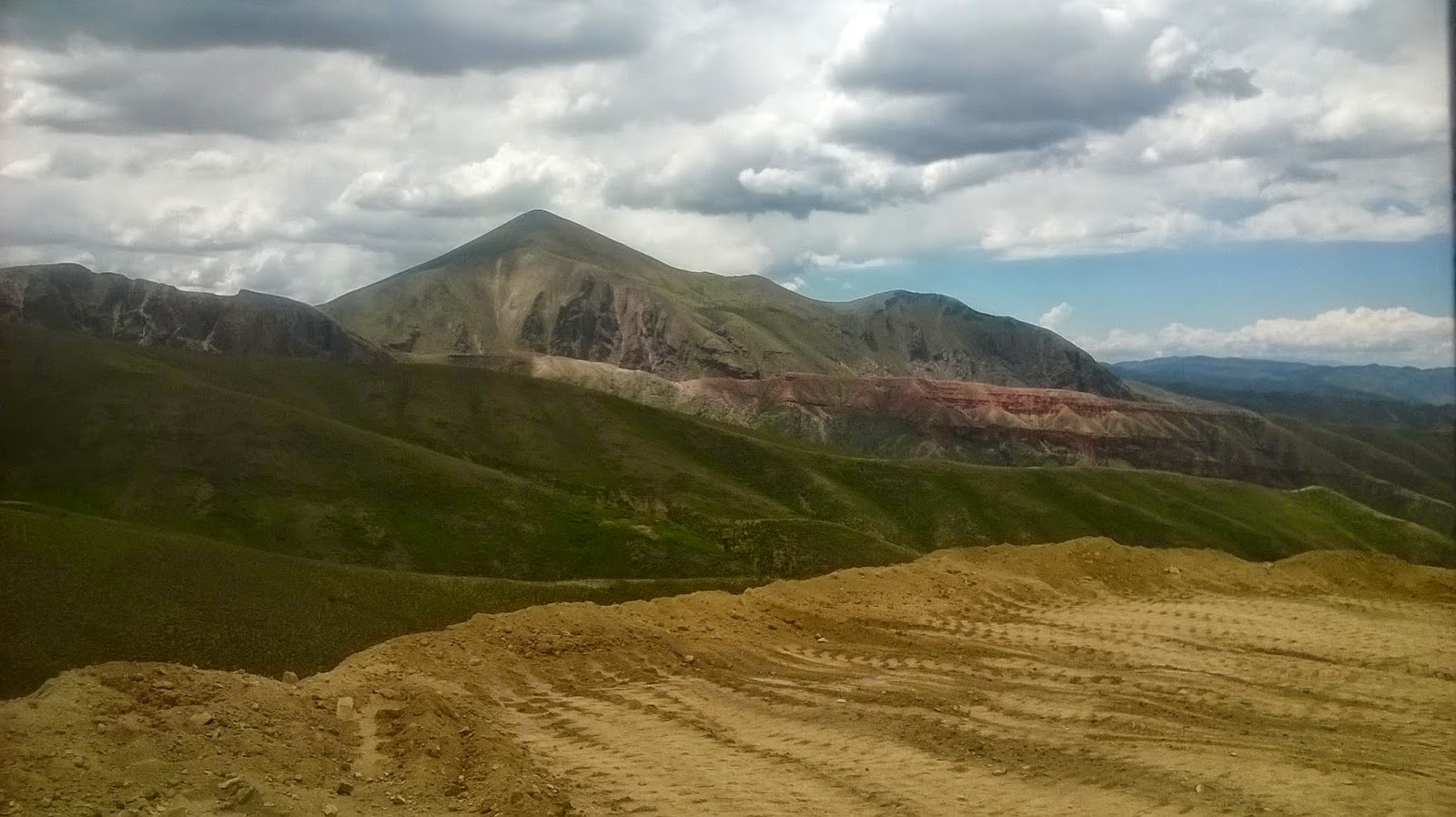
As we made our way out of the village through a valley I realised why it was preferable to take this journey in daylight. The road meanders up and down mountains and through valleys. Needless to say my heart was pretty much in my throat the whole way, although the views when I dared to look out of the window were stunning. I suppose the advantage to taking the night bus would have been that I would be none the wiser, however with the bumpy road surface I doubt I’d have got much sleep.

We eventually hit a proper main road and I could hear that every time the driver went to change gear it was taking a while for it to engage properly, which I guess wasn't surprising after the route we’d just taken.
 
We pulled into Tupiza, the stop before Villazon and everyone got off, I stayed on the bus as the engine was still running. The steward got on and explained I needed to change for a bus to Villazon, so much for it being direct. He helped me with my bag and showed me the bus I needed to take. It is what is known here as a micro, kind of like a minibus, my big rucksack was tied on the roof rack and I ended up squeezed in the back.
 
I arrived in Villazon at 3.30pm and as soon as I got off the bus I was accosted by people wanting to sell me onward bus tickets from La Quiaca. As I needed a ticket and the price was cheaper than if I bought from La Quiaca I went to the office.
 
I had a scary moment when the guy said he needed to take my passport next door to finalise the ticket as his computer wasn’t working. I got a bit shrill and insisted I follow him especially as I had already handed over the cash. Thankfully it was all fine, but I’d rather overreact in this situation especially when my passport is involved.

From there it was a five minute walk to the border. I crossed a bridge then joined a queue for the Bolivian window first to get stamped out. I then moved along to the Argentinian window to get stamped back in. After this there is a bag search area, but the guy searching my bag was very lack lustre so it took all of two minutes.
 

From the La Quiaca border post it is a good 15/20 minute walk to the bus station. As far as border towns go it isn’t too intimidating but there isn’t much there. There also isn’t a lot in the bus station either and I had a lovely six hour wait until my bus at midnight.
 
I had enough Argentinian pesos on me to get some food and just down the side of the bus station were some food stalls where I got a couple of slices of pizza for 12 pesos. I had some teabags on me and was also able to get a cup of boiling water from one of the kiosks for one peso.

The wait was long and cold so I amused myself by people watching and there seemed to be a lot of people who must have been in Bolivia on stock buying trips as the woman next to me was re-boxing a load of toys and sweets.
 
Finally, midnight came and the bus arrived. I travelled with a company called Balut. The bus was comfy enough but it was freezing cold. Ended up sat next to an old Argentinian man from Jujuy and we had a bit of a chat, although my understanding was hampered somewhat because he had hardly any teeth and a big wad of coca leaves stuffed in the side of his cheek.

Due to the fact I’d been up since 5am I was suitably tired and fell into quite a deep sleep, so deep I didn’t realise we’d stopped or that the majority of the other passengers had got off the bus until I was woken by a checkpoint guard wanting to search my bags at 4am. I remembered reading that buses coming from La Quiaca are often routinely stopped at checkpoints for searching in case of contraband being brought over from Bolivia. At least being asleep meant I didn't have to get off the bus.

At 6am we got stopped again and still in the haze of sleep I was asked by another checkpoint guard for my passport. Unlike other times when it’s been a quick check and all done with he asked several questions such as where I had come from where I was going and when I’d been in Chile. Seemingly satisfied he moved on. We finally arrived in Salta at 8am.

Wednesday, 11 March 2015

Red, red wine...

After leaving El Bolson my next port of call was the city of Mendoza in the heart of Argentina's wine country and home to malbec.

I used Andesmar again for the 21 hour journey and as El Bolson doesn't have a main bus terminal the coaches stop at their main company office in the town, these are all quite close to one another so fairly easy to locate.

First surprise of the journey was that the bus was actually early. After lunch, which comprised of the now standard ham and cheese roll with mayo, was a game of bus bingo! A great way for me to practice my numbers, I didn't win but the woman behind me did and she got a bottle of wine.

Dinner consisted of the most carbs I have ever seen as part of a meal - bread roll, slice of focaccia, muffin, slice of cheese and ham followed by a chicken cutlet and mashed potatoes! Thankfully I still had some tomato and chickpea stew leftover so supplemented my mash with this just to give it some colour! 

The coach arrived in Mendoza on time too - another first. I had booked to stay at Hostel Mora and it was a fairly straightforward 10/15minute walk from the bus station. My main reason for choosing this particular hostel was that it offered a free wine hour every night, secondly there were pancakes for breakfast. 

I was in Mendoza for four days and spent the first two exploring. As far as cities go it isn't a sprawling metropolis so it was fairly easy to navigate and the centre is concentrated around Plaza Independencia. There are four further plazas around Independencia, which are equi-distant from one another - Plaza Italia, Plaza Chile, Plaza San Martin and Plaza Espana. My favourite was Plaza Espana because I liked the tiled seats and fountain.

I also wandered out to Parque Central, which was about a 20 minute walk from Independencia down Avenida Mitre. I took some food with me from the vegetarian (yes, vegetarian) take away round the corner from my hostel. There were actually two veggie places in the vicinity - I thought the fact there was one was pretty awesome but two! The park was pleasant with plenty of grassy areas to sit and it was a nice place to while away some time.

The next night the hostel was organising an asado (Argentinian bbq) for 120 pesos and as I had yet to experience this particular part of Argentinan culture I signed up - unfortunately it was cancelled due to there not being enough interest. I was particularly disappointed especially as I'd eaten hardly anything all day in preparation.

The following day one of my fellow dorm mates told me about a buffet place she had been to during her last trip to Mendoza, which did lots of meat dishes and had a built in asado. At 140 pesos all you can eat how could I say no especially after the disappointment of the previous night! The place opened at 8.30pm and we were the first people in there, which was good as by 9pm it was heaving. 

The food was a-mazing, now I'm not the biggest meat eater but the dishes I tried were delicious. The slow cooked lamb in a tomato based sauce was to die for. Needless to say I went back to the hostel that night painfully full.

  
As I was in wine country it would have been rude not to at least visit some wineries during my stay. I booked to do a whole day bike and wine tour for 600 pesos on my last day. I would get to visit 3 wineries and have lunch at one. I was a little apprehensive about how wise it would be to ride a bike after a day of wine drinking but I thought it would be more fun than going in a bus. 

However, the morning of the tour the receptionist told me that unfortunately due to issues with the transport supposed to take us to the bikes the company had to cancel the tour. I was pretty gutted to say the least especially after the asado got cancelled earlier in the week - things didn't seem to be going my way. As it was my last day I couldn't try and book for another day either.

All was not lost though and I was able to book on a half day normal tour instead visiting two wineries and an olive oil producer.

The first winery was called Vistandes and was quite a modern set up. We got told about the wine making process then came the tasting. First up was a white wine (I forget what it was) but despite its fruity smell it was too dry for my taste. The second was a malbec but again I wasn't that blown away by it.

Next up was Pasrai an extra virgin olive oil producer. Again the process of making olive oil was explained to us and afterwards we were able to sample several oils from plain to flavoured ones. My favourite was the garlic infused oil, didn't like it enough to warrant buying a bottle to carry around with me though.

Final stop was a small family run winery called Don Arturo. Unlike Vistandes the winery was actually more like what I imagined one to be like - whitewashed buildings, grapevines, barrels etc and it felt a lot more personal too.

We were able to try three different wines and I discovered I have a taste for cabernet sauvignon - so much so I even bought a bottle for 60 pesos. I also liked the second malbec we sampled, which was a reserve one, however it was a little more expensive so I stuck with the cabernet sauvignon.

When I got back to Mendoza I was anxious that I needed to exchange some money for Chilean pesos ready for the next day so I'd have enough to get to my hostel. There was also the Via Blanca de Las Reinas parade to kick off the wine harvest celebrations happening in the city.

Thankfully I managed to locate a cambio office that was still open as I couldn't be bothered to try and find someone to do a blue market exchange with due to it being a bit chaotic and I only wanted to change a small amount. 

Turning water into wine - a fountain in Mendoza
After exchanging my money I secured myself a front row spot for the parade among a couple of families. As it got closer to the start time it started getting a bit more crowded. I had sort of made friends with the man next to me and his young grandson as I kindly held their spot while they went and got drinks.

The parade consisted of floats from the various provinces in the Mendoza region. On these floats are the harvest queens from each province, who get judged until one is crowned the overall National Wine Harvest Queen. In between the floats were gauchos on horses, a tractor procession, brass bands etc.

During the parade a few things were thrown from the floats into the crowd, this started with a few sweets - nothing unusual there, then progressed to pens (inwardly I was thinking health and safety would never allow this in the UK - they could take someone's eye out). If I thought the frenzy of the people around me for the sweets was bad the pens were even worse. I did manage to inadvertently catch a key ring much to the amusement of those around me.

After the pens came grapes, plums and apples. I am fairly sure if someone took a photo of me while this was going on the look on my face would have been one of bemusement mixed with fear as chaos ensued around me. 

The atmosphere wasn't violent at all and everyone around me was laughing and smiling while at the same time being very competitive. I even saw some people with baskets on sticks to help them catch stuff - serious business. My fear was mostly from the fact I didn't much want to end up being hit full in the face by an apple! I did manage to get a peach, which landed at my feet.

As if this couldn't get worse the people on the final float were throwing melons - yes that's right melons! It was at this point I regretted standing quite so close as an apple in the face is one thing, but a melon that could do some serious damage. I needn't have worried because a stealthy teenager crossed the barrier and managed to catch the one headed my way.

All in all it was a really enjoyable evening and fitting for my last night in Argentina. Also, as I missed out on some of the bigger Carnaval celebrations this definitely made up for it.

Monday, 9 March 2015

Bariloche and bohemian El Bolson

Various people I'd met along the way said I should go to Bariloche. I originally planned to stay there for 3 days before heading to Mendoza. However, while I was flicking through my trusty Lonely Planet I remembered I had wanted to visit El Bolson, which is a small bohemian town just south of Bariloche.

So it was that I changed my mind and stayed in Bariloche for just one day and spent two in El Bolson and I'm glad I did.

My first impressions of Bariloche weren't great, I arrived in the early evening and I don't know if it was due to my sleep deprivation but I just didn't get a great vibe. I didn't feel in any danger just my initial gut feeling wasn't good.

I stayed in Periko's Hostel, which was really nice and I shared a room with two German students, who like me were also heading to El Bolson the following day and were even going to be staying in the same small hostel.

My bus wasn't until the afternoon so I spent the morning wandering up the main streets in Bariloche. The town is famous for its chocolate so every other shop was one selling the product. Aside from this the other shops were just the same old touristy ones I'd come to be used to in El Calafate and Ushuaia so I was glad to be moving on somewhere a bit smaller.

I then came to the Civic Square, which had an almost European vibe to it in terms of the architecture. It also had a good view of Nahuel Huapi Lake. From there I wandered along the shores of the lake where there were small beaches and even at 11am people were out sunbathing. 

I'm not usually one for visiting churches but there was something about San Carlos de Bariloche Cathedral that drew me to it. Inside, my curiosity was rewarded with the beautiful stained glass windows, which with the sunlight pouring through them added bursts of colour to what was quite a simple interior.  

One of the reasons people stay in Bariloche, aside from the chocolate, is it's proximity Nahuel Huapi National Park. Had I been there for 3 days I probably would have done some of the hikes considering I didn't think all that much of the city itself.

I got a taxi to the main bus station, which is 2.5 miles out of the city and caught my bus to El Bolson.

The town is located at the foot of the Pittriquitron mountain. It is surrounded by forests and the Rio Quemquemtreu runs through it. It is known for being quite bohemian so you could say it is like the Glastonbury of this region.

I booked to stay at La Casa del Viajero, which is a small hostel located a 15 minute walk from the main town. Mathias, the owner of the hostel, met me at the bus stop and took me to the hostel.

On the way he explained a little bit about the town etc. He also told me that there have been a lot of forest fires in the surrounding area, which I think must be down to how hot and dry it was there and we could even see smoke from one way in the distance. I have also heard that there may have been political reasons for the fires too.

The hostel was lovely, a great place to just relax and enjoy the surroundings. There were several hammocks strung up around the grounds, perfect for lazing in.

The six bed dorm I booked was in a small wooden cabin and it had its own bathroom and kitchen. There was a veranda outside the front with comfy seats.

As the hostel was so small and out of the way, it meant it was easy to get to know the other guests and we spent most evenings drinking and chatting. As a solo traveller these are the moments you come to relish especially after a long journey when you realise you haven't had a meaningful conversation for a day or two.

Due to the laid back nature of my surroundings I spent most of the next morning in a hammock in the garden before heading to the market. The weekend market in El Bolson is quite popular as local artisans and producers display their wares from handcrafted jewellery to honey and home brewed beer. 

While I was there I saw a lot of people's attention was drawn to the smoke coming from a wooded area just above the town. It was quite close as I could even see the flames. There were planes flying over dumping water on it, the proximity of the fire to the town was a little concerning especially as the slight breeze that day seemed to have spread it a bit too.

El Bolson is definitely the type of place you could end up staying in for a while just due to it's relaxing atmosphere. It was certainly refreshing to be somewhere where I could just sit in a hammock all afternoon reading a book and not feel like I should be off doing something else.

If I hadn't already got an onward bus booked I would have stayed on for another day at least and maybe I would have gone on some of the hikes around the town, although that hammock was pretty appealing too... 

Thursday, 5 March 2015

The road less paved - experiencing Ruta 40

While I was in El Calafate I booked the next part of my journey Northwards. As it is a small town and still quite remote only a couple of long distance companies Taqsa/Marga and Chalten Travel make the journey to Bariloche.

Fitzroy mountain range in the distance
Both these companies run buses to Bariloche for the same price - 1,580 pesos. The only difference is the route, Chalten Travel goes along Ruta 40, which runs parallel to the Andes and is the longest road in Argentina finishing in Jujuy province in the very North, whereas Taqsa/Marga goes up the Eastern coast via Rio Gallegos.

I wanted to experience travel along Ruta 40 mainly because going with Taqsa/Marga would take me back along roads I'd already been on. At the time I didn't really think about the fact that there are still sections of Ruta 40, which are unpaved or that a large chunk of the journey would be overnight so I wouldn't see anything.


I bought my ticket and was told that I would need to switch buses - fine I thought at least I know beforehand for a change. The only catch was it looked like I would have to switch in the middle of nowhere as the point on the map was a junction where Ruta 40 meets Ruta 23. 

Needless to say I was pretty anxious about potentially being left in the middle of the Patagonian wilderness, but I needn't have worried because the bus continued on it's way to El Chalten until we met the other bus coming in the opposite direction. Both buses stopped, I got off grabbed my bag, crossed the road and got on the other bus much to the confusion of the other passengers.

The bus I had been on before the switch was a really nice semi-cama bus, the type I have been used to on other overnight journeys. The other bus, however was just a normal coach and when I stepped on what hit me first was the smell of festering bodies.

Now, I know that I didn't exactly smell like a bed of roses either. I'd lost count of the number of days I had worn the same long sleeved top and t-shirt combo, but the smell on this bus was pretty pungent to say the least.

I didn't have a seat number either and the bus was already really full so the only seat available to me was right on the back seat squished in among four other passengers, thankfully I didn't get the death seat in the middle.

I also noted there wasn't a toilet on board and assumed that we probably wouldn't get any food either - both of these things I would have got if I'd gone with Taqsa/Marga and at no extra cost as the tickets were the same price.


At this point I just had to embrace my decision and make the best of the journey, it could be worse I have friends who have had to endure long trips sat right next to a stinky toilet.   

I had eaten a big lunch so wasn't too hungry and I have learnt to always take a few snacks with me so the lack of food didn't bother me much. There were several stops to random service stations in the middle of nowhere so people could get something to eat and use the toilet. 

The last stop was at 1am and after this I settled in as best I could for what I could already tell would be a rather uncomfortable night especially as by now the roads were unpaved.

Despite the bumpiness of the road I managed to get a little sleep before the bus stopped in the town of Perito Moreno - note this isn't the same place where you can see the glacier - at 6.30am. I was supposed to go on to the final stop at Los Antiguos and pick up a bus at 7am, however I knew that it would take longer than 30 minutes to get there and the bus would have to come back through Perito Moreno anyway.

The majority of passengers leaving the bus in Perito Moreno were heading to Bariloche so I deduced that it would likely be the same bus coming through to pick them up. Thankfully I was right and my name was on the list of passengers supposed to be on the bus - did get a little ticking off by the driver though for getting on in the wrong place. 

The journey from here to Bariloche took 12 hours and I had a double seat to myself. Although, I had gone from one extreme to the other and was now sat at the front of the bus so I had to endure the driver's choice of music for the entire journey. This ranged from Argentinian pop to more mariachi style music.

I would say despite the discomfort, lack of on board meals and toilet I'm glad I did that journey. I got to see the Fitzroy mountain range in the distance and lots of other scenery I wouldn't have otherwise seen.

From previous travel experiences it is always the bits that don't pan out how you think they will that are the ones you will remember. However, if someone asked me to make that trip again I would choose Taqsa/Marga without a doubt.

Monday, 16 February 2015

Journey from Patagonia to the Land of Fire

I am writing about my journey to Ushuaia purely because nothing I had read beforehand about taking an overland route really went into detail about what happens, so as you will see below I was fairly unprepared. This makes for a good story afterwards but at the time was a little stressful and bewildering (especially when I had already made a 20 hour journey prior to this one).

Most buses to Ushuaia leave from Rio Gallegos, which is where I picked mine up from too. Firstly, the best piece of advice I can give to anyone travelling by bus in Argentina is (in my experience) that most will arrive at the final destination later than scheduled so if you are getting a connecting bus leave at least 2 to 3 hours between them to be on the safe side.

I was travelling with Tecni-Austral and when the coach arrived it looked more like a police riot van with a big heavy grill over the windscreen. I'd heard that some of the roads were unpaved so assumed this is why they had the added protection and not because we were going to be attacked by pitchfork wielding locals - but you never know!

The coach wasn't the best I've been on, but considering the journey should take around 10 to 12 hours and was during the day I wasn't too worried. 

At the Terminal de Omnibus in Rio Gallegos make your first port of call the desk of your coach provider. For part of the journey, which I was unaware of at the time, the coach will cross into Chile so it is sort of like checking in for a flight but not so stringent. The person at the counter will check your ticket and cross your name off the list of passengers due to travel. 

The only reason I went to the desk was out of habit to check the bus was running etc. However, a couple of passengers didn't do this and had to rush back inside to do so before they were allowed on-board.

Unless you want a hefty fine, make sure you dispose of or eat any fruit and vegetable products you have on you. I don't know if this is true of all the coach companies but the host on the bus I was on came round just before the border with a bin for any food you might want to throw away.

I panic ate the two carrots I had on me much to the amusement of the host and some of my fellow passengers. Well, they were likely the only vegetables I was going to have that day so I wasn't going to waste them. I also had a couple of bananas but they hadn't travelled well so I was happy to dispose of them.

The border formalities took a little while as you have to be stamped out of Argentina and stamped back into Chile as well as putting all your hand luggage through an x-ray.

Back on the bus and by this point having consulted the map app I have on my phone, I guessed we would be reaching a water crossing. The map wasn't wrong and soon enough we reached it.

The weather by now had turned and was windy, rainy and cold so I'm not going to lie I probably didn't appreciate crossing the Strait of Magellan as much as I could have done.

Also, bearing in mind I had come from further north than a lot of people on my coach I looked like that one tourist who comes back to the UK from warmer climes still in summer clothes.

Unlike the majority of other passengers on the coach, who looked liked the contents of an outdoor adventure store had thrown up on them, I'm pretty sure I was the only one rocking flip flops! I did have a fleece and was wearing trousers albeit of the thin cotton kind so I didn't look entirely like a fish out of water.

Once we reached the other side we got back on the bus and had another couple of hours driving along unpaved roads - imagine a coach swaying from side to side like a boat rocking on a rough sea and that's pretty much what the journey felt like!

We reached the next border crossing and were stamped out of Chile (this was much quicker than getting into the country). Don't worry at this point if you haven't got a stamp stamping you back into Argentina as the Argentinian border post is a bit further up the road.

When we reached Rio Grande, which is about 3 hours from Ushuaia, we are told to get off the bus as there will be another coach arriving to take us the rest of the way. No indication as to how long this might be, but at least I wasn't the only one in this predicament as the majority of people on the coach were going on to Ushuaia. After about 30 minutes the new coach arrived we all piled on and 3 hours later arrived at the end of the world only 3.5 hours late!

Despite all the faff involved and getting on and off buses and ferries, I'm glad I took an overland route. Although the scenery did get very monotonous at times, it was stunning - vast plains of windswept, sun bleached emptiness occasionally punctuated with the odd hill, lake or lone estancia. 
As we drove into Ushuaia, even though it was dark, I could tell we were in Tierra del Fuego as the terrain became more mountainous and I imagine in daylight it would have been quite spectacular.

Sunday, 8 February 2015

Falling for Iguazu

My main reason for visiting Puerto Iguazu, like most people who come here, is to see the Iguazu Falls. They are located on the border between Argentina and Brazil and consist of around 275 separate waterfalls.
 
I decided to give myself three days in Puerto Iguazu as in this part of the country weather can be unpredictable and the falls are best viewed on a clear day.

I stayed at Hostel Bambu Mini in Puerto Iguazu, it had a nice laid back atmosphere and from what I could gather quite a high turnover of guests as most people seem to only stay a couple of nights before moving on.

Before I arrived I pondered whether to take a tour to the falls as I wasn't sure if it would make life simpler, however it is really easy and cheaper to go independently. 

I took a Rio Uruguay bus from the bus station to the main entrance of the Iguazu National Park. A return ticket cost 100 pesos. 

I arrived at the park at about 10am and it was already quite busy with several school groups and other tours. Entry to the park cost 260 pesos.

Once inside I got myself a map and headed for the lower falls trail - most people head straight for the upper trail or take the train to the Devil's Throat section, but I'd been advised by a guest at the hostel to do the lower trail first as it is usually quieter and gives the best overall view.

The falls are located in what remains of the rainforest in this region and all of the trails take you through this. There are lots of signs advising you to be aware of the various animals you may encounter including jaguars! Covered in a pungent mix of suncream and insect repellent I was good to go.

The lower trail is the longest of the three main ones and I could hear the sound of the falls long before I first saw them. As I rounded the final bend the trail opened out and I caught my first glimpse of them through the clearing it was truly breathtaking, as I made my way along the path it just got better and better. I was somewhat awestruck by it all.

At the end of the lower trail you can stand in front of the Salto Bossetti fall. Even stood quite a few metres from the very end of the platform I still got a nice soaking from the spray. I wasn't complaining though as it was nice to cool down as even at 11am the temperature was in the high 20s.

I then walked the upper trail, which is shorter than the lower and takes you along the top of several of the falls the view from the top was good but not as impressive as the lower trail.

Finally, there is a train that takes you up to the Devil's Throat trail. Approximately half of the river's flow falls down the Devil's Throat (Garganta del Diablo), which is made up of 14 falls. It is 82 metres high, 150 metres wide and 700 metres long and the border between Argentina and Brazil actually runs through it.

The trail to get there is almost 1km long across metal walkways suspended over the river, which open out to a viewing platform right on the edge. The sound was deafening and there was a huge amount of spray coming up from the water not surprising really and when the wind changed direction it actually felt like heavy rain.

It is advisable to keep a plastic bag or waterproof case handy to protect any cameras. I actually used the camera on my phone for the photos at this part as I knew it could withstand a bit of wet better than my main camera. I also didn't bother with any waterproofs and I had pretty much dried off by the time I walked back along the trail.

During my time in the park I saw and heard lots of wildlife. It's true what they say about the noises in the rainforest and at times it was so loud it sounded like someone was playing a recording of insects. Thankfully I didn't encounter any jaguars but I did see a caiman in one of the little rivers, numerous colourful butterflies, a small jumpy spider and a coati.
 
The coatis are notorious in the park for stealing food and can be quite aggressive. I chose to give them a wide berth as much as possible until I was sitting in the shade reapplying my sun cream and one decided to try and steal the bottle! Thankfully it got distracted and ran off but to be honest I probably would have let it take the bottle rather than risk getting bitten as the warning pictures around the park of previous injuries to visitors didn't look nice - I also didn't fancy putting my rabies vaccine to the test quite so early on in the trip either!

Puerto Iguazu itself is very much geared to tourists but does still retain a bit of small town charm. It actually reminds me of the many beach towns in the South West of England during the height of summer only minus the beer bellies on display (thank goodness).

Paraguay on the left and Brazil on the right
On my last full day in the town I wandered out to the point at which you can see Paraguay and Brazil across the Rio Parana and Rio Iguazu respectively. Where the Rio Parana and Rio Iguazu meet you can tell as the colour changes. The Iguazu used to be blue but due to deforestation having loosened the soil it means when it rains what's left flows into the river turning it brown. 


Saturday, 7 February 2015

The wheels on the bus go round and round all the way to Puerto Iguazu

I thought the journey to Puerto Iguazu deserved a post of its own. Unlike in the UK, coach travel is the main mode of transport for long distance trips in Argentina as the country doesn't have a developed rail system and it is usually cheaper than flying.

Given that Argentina is the 8th largest country in the world and approximately the same size as India it isn't too surprising that a short coach journey here is considered to be anything under 12 hours. 

The 17 hour journey to Puerto Iguazu in the far North East of the country near the borders of Brazil and Paraguay is actually pretty good going. The main draw for people coming to this part of Argentina is the Iguazu Falls, more on them later.

Before leaving the UK I had booked a few of my tickets online via Voy en Bus. I also read quite a lot about the main Retiro bus station in Buenos Aires, not much of it was positive. In an attempt to be as prepared as possible the day before my first coach journey I went to try and make sense of it all.

The bus station is spread over three floors with luggage lockers on the lower ground floor, departures/arrivals on the first floor and ticket sales on the upper floor. With 75 stands for the various coaches I could tell it was going to get complicated.

Some of the departures appear on a screen telling you which stand to go to, however not all coaches are shown adding another layer of confusion. There is an information booth, so I decided that I would make that my first point of call when I came to use the bus station for real. 

The evening before my scheduled departure I got chatting to a fellow Brit at the hostel and it turned out he was also leaving for Puerto Iguazu at the same time the following day. We decided to share a taxi to the bus station and agreed to leave just after 2pm to give us time before our coaches left at 3pm.

On the day of departure we left the hostel at 2.15pm, in hindsight we probably should have left at 2pm, due to heavy traffic it took us just over 30mins to get to the bus station giving us less than 10 minutes to find our respective coaches (lots of companies run the same routes and confusingly depart at the same times too).

The taxi driver dropped us off but not at the main entrance. With only a few minutes to spare and no idea which way the info booth was we checked the screens, my fellow travelling companion's bus was on the screen so he headed to the stand.

I was travelling with El Rapido Argentino and it wasn't listed but I could see a coach bearing the name of the company outside the window. Taking a punt and by this time pretty stressed I ran outside and asked the driver if it was going to Puerto Iguazu - thankfully it was and I loaded my backpack. The moral of this part of the story is to always leave plenty of time. If it hadn't have been the coach I needed I probably would have missed it.

Having now experienced an Argentinian coach I can safely say that it was definitely much comfier than any I've been on in the UK and outside of it for that matter. The seats are wide and almost armchair like. I had booked a semi-cama seat, which means the chair reclines 140 degrees and attached to the back of the seat in front is a leg rest, which folds down making it bed-like.

I had a window seat and the views were pretty incredible just vast expanses of green fields, farmland and forests for as far as the eye could see and no signs of civilisation for many miles. The towns we did pass reminded me of the sort you get in old western films with just a few buildings and a lot of dirt roads. Massive contrast to Buenos Aires.

At the 7 hour mark (10pm) we were given a meal a bit like you get on a plane except you don't have a choice. On the tray was a pastry, the flattest bread roll I have ever seen, bread sticks, a slice of ham quiche and a weird gelatinous thing, which I think was supposed to be pudding.

In addition to this, we had a hot dish, which consisted of some sort of carrot/potato mash and a breaded cutlet of generic grey meat. Needless to say I mostly ate the mash.

I must admit I slept fairly well, although the air con was cranked up so high it was freezing. Anticipating this I had packed a large sheet and wrapped myself up in it.

I woke up at about 8am and braved the on board toilet for the first time. Needless to say as with toilets on most forms of public transport it wasn't particularly pleasant!

The view out of the window had changed and was much more tropical with lush green palm trees and banana trees providing much of the scenery. This was definitely the South America I had imagined.


We were delayed slightly by a protest/strike going on across one of the main roads - a common occurrence in this part of the world I'm told. I'm not sure what it was about but there seemed to be a disproportionate amount of police and army dotted around in case things kicked off.

I arrived in Puerto Iguazu an hour later than scheduled and was blown away by how hot it was - well seeing as I'm pretty much in rainforest country I shouldn't have been too surprised by this.


Thursday, 5 February 2015

All is Bueno in Buenos Aires


My journey to Buenos Aires was mostly uneventful until the customs declaration forms came round. All was pretty standard except for one paragraph asking if you were bringing semen in – random!

Once I’d made it through immigration, my next mission was to get from the airport to America del Sur Hostel in San Telmo district. The hostel recommended Manuel Tienda Leon a door to door shuttle service, which was cheaper than getting a taxi and quicker than a public bus.

The main thing I noticed while on the journey from the airport was how European the city feels in terms of architecture. In a way it was quite comforting how familiar it seemed despite being miles away from home.

The hostel staff were warm, friendly and helpful. I booked a four bed mixed dorm, it was pretty basic in terms of décor but it was clean and well presented. I do love a hostel that provides brekkie, again this was quite basic but enough to keep me going and the dulce de leche (caramel) spread was delicious on toast. 

During breakfast on my second day a guy called Adam from Demasiado Tours handed me a leaflet for a free walking tour he was running of the main historic sites. I thought it would be a good opportunity to acquaint myself a bit more with the city plus it was FREE!

They say the best things in life are free and the tour was no exception. It was excellent and I would highly recommend it to anyone planning to visit Buenos Aires. I definitely came away feeling I had learnt a lot more about Argentina/Buenos Aires' history. We also got to see the barbers where the current Pope used to get his haircut! 


Having been told on the tour that one thing worth checking out is the Sunday market in San Telmo that’s exactly what I did. The market occupies the entire length of Defensa Street and there are a variety of stalls selling all manner of things from handicrafts and souvenirs to clothes and homewares. Having been to my fair share of markets on previous travels this one is definitely one of the most laid back, despite it being crowded it didn’t feel hectic and the stallholders didn’t seem too pushy either.

I also moved to my second hostel in the city (I ended up booking two because I couldn’t decide between them) Hostel Estoril, which is near Plaza de los Dos Congresos, it was a 15-20 minute walk from America del Sur Hostel. This should be fine I thought forgetting that I would be laden with all my luggage at what was quite possibly the hottest part of the day. Needless to say I was a bit of a sweaty mess by the time I got there.

The hostel is quite a contrast to my previous one as it is in an older building and has a bit more character to it. It certainly had a bit more of a homely feel to it with a nice lounge area and comfy sofas. Breakfast was included here too and one of the members of staff would cook you eggs if you wanted, I of course took them up on this offer every day.

On my last day in Buenos Aires I decided to do the other free tour offered by Demasiado Tours this time around the more upmarket districts of Retiro and Recoleta. As with the previous tour it was excellent. One of the things we saw was the memorial to those who lost their lives during the Falklands War or as it is known here the Malvinas War. Ironically the memorial is directly opposite the Torre Monumental, which had been given as a present to the city in 1810 by the British community living here.

We also visited Recoleta Cemetery, which contains 4,691 mausoleums it is quite something, especially the different architectural styles. Many prominent people have graves there including Eva Peron (Evita).

Finally, no trip to Buenos Aires would be complete without at least seeing or trying tango. My hostel organised a package where you could take part in a tango lesson then afterwards have a meal and watch a show. The lesson was good fun and you learnt the basic tango steps. The show afterwards was incredible and made me wish I was a better dancer.