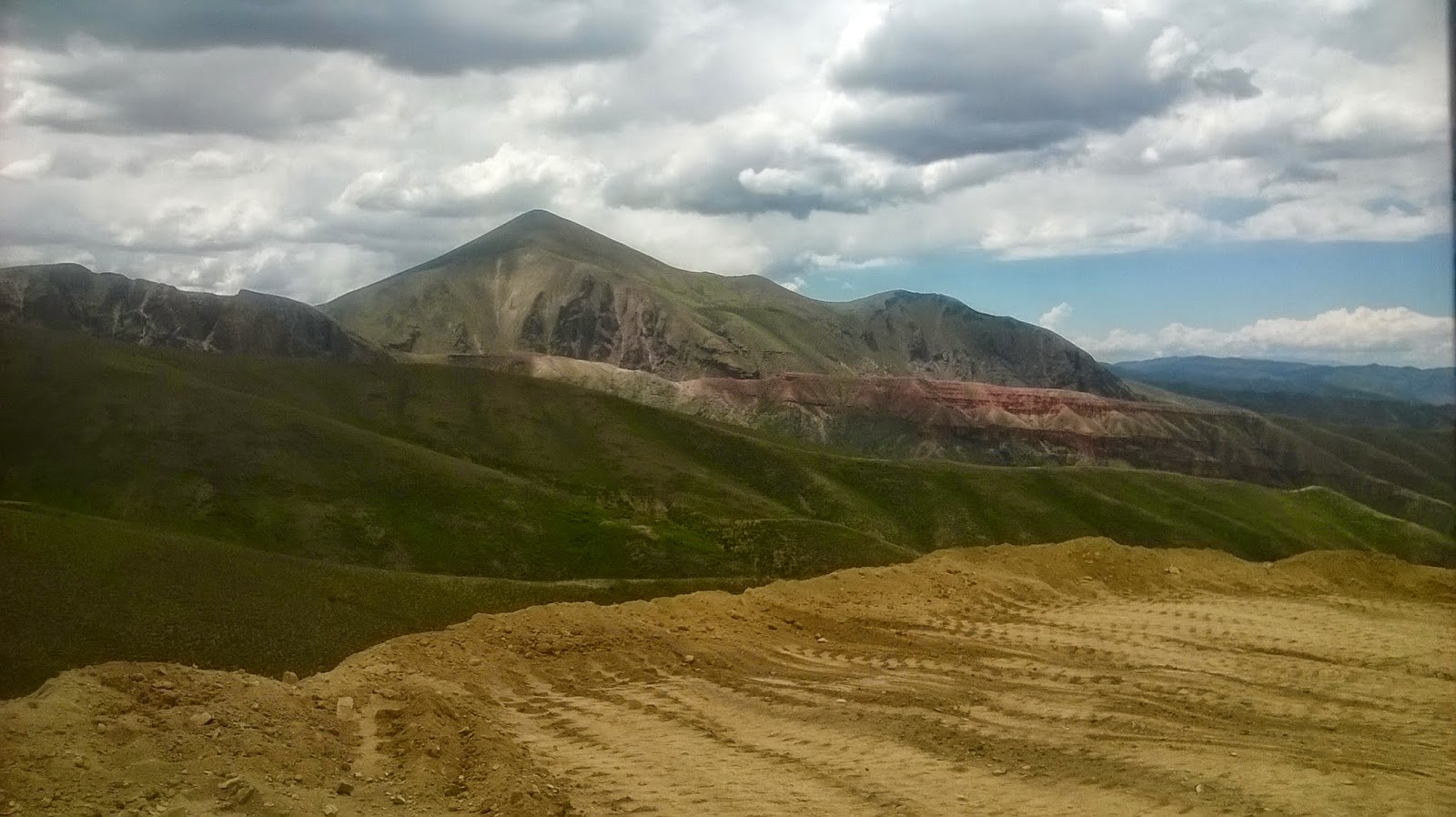
After arriving in Iquique, which is a beach town on the northern coast of Chile, at the ungodly hour of 5.30am I hopped in a taxi and headed straight to Backpacker's Hostel.
After partially checking in I was able to leave my bag in the left luggage and endeavoured to find a quiet corner in the lounge to get some sleep. About 20 minutes of light cat napping later, I was joined by an English couple, Mitch and Clare and a Frenchman named Thomas.
Once the sun had finally risen, it was a gorgeous sunny day. Not wanting to waste it catching up on sleep I joined Mitch, Clare, Thomas and a Dutch guy called Jimmy on a trip to the ghost town of Humberstone, which was one of my main reasons for coming to Iquique, well that and the beach of course.
We caught a micro from the town centre for 2,000 pesos each and were dropped off by the side of the highway. The village was a short 10 minute walk away and I was pleasantly surprised to see that it is now a museum as I expected it to be like Pampa Union, the town I saw on the way to San Pedro de Atacama.
Humberstone used to be a thriving sodium nitrate mining town. In 1929 synthetic ammonia was developed by the Germans and this marked the start of the decline for the town. Operations in the town finally ceased in 1960. Entry to the museum cost 3,000 pesos.
The first part of the town is where all the dwellings were, along with the hospital. It is possible to wander around some of the buildings and a few felt quite eerie. As the town grew in population so did the amenties available to residents and there was a theatre, basketball stadium, school, hotel, pub and even a swimming pool! I couldn't get over how well preserved everything was.
On the other side of the town was the main industrial area where all the mining took place. In contrast to the town this area was very rusty as all the buildings are made from corrugated iron. We were also surprised to see that a lot of the machinery remained in tact and hadn't been looted.
We spent a good three hours just wandering around before catching a micro back to the town.
The Backpacker's Hostel isn't located in the centre of town, rather it is set just metres from the beach and of course a visit to Iquique wouldn't be complete without at least some beach time. I spent a pleasant afternoon catching some rays and going for a dip - the water was very pleasant.
The town centre is a good 15 minute walk from the hostel and Calle Baquedano is the main thoroughfare. It remimded me of something from the Wild West with wooden boardwalks and buildings. It was really pleasant and the end of the road opens out into a square with a rarher elaborate fountain.
The only thing seemingly lacking in Iquique at this time of year (well it is autumn after all) is much of a mid-week night life. However, we did find a bar offering cheap(ish) mojitos along Baquedano. We were the only people in there along with a load of Chilean bikers so it was quite entertaining especially when they all rode off into the night.
I could have very easily spent more time in Iquique relaxing on the becah and staying in the hostel, which had a really great atmosphere. However, I had to push on further north to Arica.
Buses to Arica leave fairly regularly from Iquique with several departures a day. I managed to get a ticket for 6,000 pesos with Pullman Carmelito. I opted to do the 40 minute walk the to the bus station, which in hindsight was a bit ambitious in the heat, with a slight hangover and all my stuff. Needless to say by the time I got there I was very hot and bothered and to top it off the bus was 20 minutes late.
The five hour journey was fine despite the steward taking my passport for a large portion of the journey as he said it would make it easier when we reached the checkpoints on the way. This made me quite twitchy, mostly because I was worried I might forget to get it from him in the commotion getting off the bus and getting my stuff. Thankfully he banded it back before we reached Arica.
I arranged to stay at Arica Unite, which is situated a 20 minute walk from town but is only 10 minutes from the bus station. Arica is in the far north of Chile and is close to the border with Peru so as you can imagine it is a main interchange point for people heading that way or coming back.
It is also possible to get to La Paz from Arica and this is the journey I planned on making.
I had one full day in Arica and decided to check out the Museo Arqueologico. To get there I took a colectivo amarillo, which is a taxi with a set route and can take more than one passenger at a time, heading to Azapa. The colectivos depart from Calle Chacabuco. The driver dropped me off outside the museum and explained where I would be able to get a colectivo back to town. The journey cost me 1,000 pesos.
Entry to the museum was 2,000 pesos and upon arrival I was handed a large sheaf of papers, which was the English translation of all the exhibits. The museum has exhibits on the various civilisations that lived in the region and it also houses some mummies from the Chinchorro culture (6,000 - 2,000 BC).
The museum was good but didn't really tell me much I didn't already know from the museum in Salta. The mummies were interesting and very different to the ones in Salta due to a different process used when preserving the bodies.
Catching a colectivo back to Arica was fairly easy and I wasn't waiting long before one appeared. I got dropped off at Calle Chacabuco and wandered to the centre where you can see El Morro, which is one of the main focal points in the town. If I had planned my time better I could have walked to the top as the views would probably be quite spectacular.
Needless to say I'm glad I made the journey back to Chile to visit these two places.
Friday, 8 May 2015
Sunday, 3 May 2015
Sedate Salta
I arrived in Salta at 8am on Good Friday. Due to a lack of Argentinian Pesos I decided to walk the 1.2 miles from the bus station to Sol Huasi Hostel. It was a pleasant morning so the walk wasn't too bad despite feeling pretty hungry.
The hostel was in a great location just off the Plaza 9 de Julio, which is the main square. Unusually I was able to check in and go to my dorm room straightaway, which was great and gave me a chance to freshen up before heading out again to get money and food.
As it was Good Friday the centre of the city was fairly quiet with just a few other tourists wandering around. Plaza 9 de Julio is one of the nicest squares I've seen on my travels it was filled with lots of trees, plants and pleasant places to sit and watch the world go by. The plaza is surrounded by lots of cafés and restaurants. The main feature is the Iglesia Cathedral, which houses the ashes of General Martin Miguel de Güermes.
I had dinner at one of the small cafes just overlooking the square and treated myself to the 'Menu del Dia', which comprised of two courses for 75 pesos. I had empanadas to start followed by locro. The latter contained chickpeas, butter beans, meat and what I believe was chopped up intestines (I fished these bits out as they were easy to identify).
While I was eating, the evening mass in the cathedral was broadcast over the loudspeakers into the square and culminated in a procession around the plaza. It was interesting to watch especially as this doesn't tend to happen much in the UK.
When I was in San Pedro de Atacama the WiFi adapter on my laptop broke so while I was in Salta I set myself the task of finding a computer shop, which sold a USB adapter I could use instead. Compunoa had exactly what I needed for 90 pesos and because my laptop doesn't have a CD drive the guy in the shop even helped install it all for me at no extra cost.
I visited the Museo de Arqueologia de Alta Montana, which documents the discovery of three mummies found at the top of Llullailaco volcano, 6,700m up. Due to the climate the bodies and items buried with the them were almost perfectly preserved. The museum was really interesting and shows how the bodies were found and the theories surrounding why they were buried there. The main theory is that they were buried as part of a sacrificial ritual.
There is only ever one of the mummies on public display at any one time and while I was there it happened to be 'Lightning Girl'. She is named as such because archaeologists believe at some point the area where the girl was buried was struck by lightning and this is what caused the scorch marks on her face and clothes. It was amazing and also a bit eerie to see how intact the body and face was even down to her still having teeth, hair and nails.
One of my main reasons for visiting Salta was because I had heard the bus journey across the Andes to Chile is pretty spectacular. Two companies offer services to Chile - Pullman and Gemini. I opted for Pullman purely because when I got to the bus station, there wasn't anyone in the Gemini office. My ticket to Iquique, on the Northern coast of Chile, cost 1,215 pesos and I would need to change buses in Calama. It is useful to note that Pullman buses only depart for Chile on Sundays, Tuesdays and Thursdays.
My bus left at 7am and was full of other tourists heading to San Pedro de Atacama as this is one of the popular routes for that journey. I had managed to get myself a window seat and sat back to enjoy the views. The journey was stunning, but after everything I had seen in Bolivia it kind of fell short for me. I appreciated it, but I wasn't that amazed by it either, which was a shame.
The border crossing was fairly straightforward although a couple of people fell foul to the affects of the altitude with one girl fainting just as she was about to put her bag through the x-ray machine. We were also held up by one passenger, who was trying to bring some sort of tree into Chile and was having a rather heated debate with the customs officer.
As predicted when we reached San Pedro de Atacama the majority of the passengers got off and it was only a handful of us heading on to Calama. There is no main bus terminal in Calama so I had to wait at the main Pullman office for my connection to Iquique at 11pm. The office was perfectly nice with a waiting room and there was even a TV showing some soap operas. I bought myself a completo for dinner from the stand outside as there didn't really seem to be anywhere else to get food along the street.
The bus finally arrived and it seemed to be men who made up the majority of the passengers, possibly miners headed home for a bit. The bus was comfy enough, but it was freezing cold so much so that at one point I had to put my woolly hat on. Thankfully I think so many people complained that in the end they turned the heating up and gave us all blankets to the point where I was actually a little too hot by the time the bus pulled in to the main bus terminal at Iquique at 5.30am.
The hostel was in a great location just off the Plaza 9 de Julio, which is the main square. Unusually I was able to check in and go to my dorm room straightaway, which was great and gave me a chance to freshen up before heading out again to get money and food.
As it was Good Friday the centre of the city was fairly quiet with just a few other tourists wandering around. Plaza 9 de Julio is one of the nicest squares I've seen on my travels it was filled with lots of trees, plants and pleasant places to sit and watch the world go by. The plaza is surrounded by lots of cafés and restaurants. The main feature is the Iglesia Cathedral, which houses the ashes of General Martin Miguel de Güermes.
I had dinner at one of the small cafes just overlooking the square and treated myself to the 'Menu del Dia', which comprised of two courses for 75 pesos. I had empanadas to start followed by locro. The latter contained chickpeas, butter beans, meat and what I believe was chopped up intestines (I fished these bits out as they were easy to identify).
While I was eating, the evening mass in the cathedral was broadcast over the loudspeakers into the square and culminated in a procession around the plaza. It was interesting to watch especially as this doesn't tend to happen much in the UK. When I was in San Pedro de Atacama the WiFi adapter on my laptop broke so while I was in Salta I set myself the task of finding a computer shop, which sold a USB adapter I could use instead. Compunoa had exactly what I needed for 90 pesos and because my laptop doesn't have a CD drive the guy in the shop even helped install it all for me at no extra cost.
I visited the Museo de Arqueologia de Alta Montana, which documents the discovery of three mummies found at the top of Llullailaco volcano, 6,700m up. Due to the climate the bodies and items buried with the them were almost perfectly preserved. The museum was really interesting and shows how the bodies were found and the theories surrounding why they were buried there. The main theory is that they were buried as part of a sacrificial ritual.
There is only ever one of the mummies on public display at any one time and while I was there it happened to be 'Lightning Girl'. She is named as such because archaeologists believe at some point the area where the girl was buried was struck by lightning and this is what caused the scorch marks on her face and clothes. It was amazing and also a bit eerie to see how intact the body and face was even down to her still having teeth, hair and nails.
One of my main reasons for visiting Salta was because I had heard the bus journey across the Andes to Chile is pretty spectacular. Two companies offer services to Chile - Pullman and Gemini. I opted for Pullman purely because when I got to the bus station, there wasn't anyone in the Gemini office. My ticket to Iquique, on the Northern coast of Chile, cost 1,215 pesos and I would need to change buses in Calama. It is useful to note that Pullman buses only depart for Chile on Sundays, Tuesdays and Thursdays.
My bus left at 7am and was full of other tourists heading to San Pedro de Atacama as this is one of the popular routes for that journey. I had managed to get myself a window seat and sat back to enjoy the views. The journey was stunning, but after everything I had seen in Bolivia it kind of fell short for me. I appreciated it, but I wasn't that amazed by it either, which was a shame.
The border crossing was fairly straightforward although a couple of people fell foul to the affects of the altitude with one girl fainting just as she was about to put her bag through the x-ray machine. We were also held up by one passenger, who was trying to bring some sort of tree into Chile and was having a rather heated debate with the customs officer.
As predicted when we reached San Pedro de Atacama the majority of the passengers got off and it was only a handful of us heading on to Calama. There is no main bus terminal in Calama so I had to wait at the main Pullman office for my connection to Iquique at 11pm. The office was perfectly nice with a waiting room and there was even a TV showing some soap operas. I bought myself a completo for dinner from the stand outside as there didn't really seem to be anywhere else to get food along the street.
The bus finally arrived and it seemed to be men who made up the majority of the passengers, possibly miners headed home for a bit. The bus was comfy enough, but it was freezing cold so much so that at one point I had to put my woolly hat on. Thankfully I think so many people complained that in the end they turned the heating up and gave us all blankets to the point where I was actually a little too hot by the time the bus pulled in to the main bus terminal at Iquique at 5.30am.
Monday, 27 April 2015
Shake, rattle and rolling my way to Salta
Before getting to Uyuni I had read a bit about getting to Salta in
Argentina. As Bolivian buses aren’t allowed across the border I would have to
cross on foot at a town called Villazon and pick up a connecting bus in La
Quiaca to Salta.
We made a few stops in tiny hamlets and picked up a
few people before making a stop in a village called Atocha. I overheard the
driver say we’d stop for an hour, so I took the opportunity to stretch my legs
a bit and people watch. Ended up chatting to a young girl, who also got on in Uyuni and I shared some chocolate with her.
I arrived in Villazon at 3.30pm and as soon as I got off the bus I was accosted by people wanting to
sell me onward bus tickets from La Quiaca. As I needed a ticket and the price was cheaper than if I bought from La
Quiaca I went to the office.
It was recommended to take the bus to Villazon during the day due to
the condition of the road. My first task when getting to Uyuni was to sort out
my bus and then find somewhere to sleep. There is no main bus terminal in
Uyuni, however all the bus company offices are situated around the top end of Avenida Arce (after the plaza with the church), Cabrera and Peru. The buses
pick you up from outside the office you booked with. After trying two companies, which only had
evening departures, I found one, Tupiza Travel, that had a bus leaving at 6am the following day for 60
Bolivianos.
Due to the early start I endeavoured to find a hostel close to the bus
company’s office. After passing a few dubious looking places I stumbled upon a
fairly modern looking hotel about a 2 minute walk from where I’d have to get
the bus.
As I usually try to book ahead I didn’t have much practice with regards
asking in Spanish for a room so I turned to the limited phrase section of my
guidebook to help. In my rush I accidently turned to the Portuguese section,
realised what I was saying didn’t seem right and noticed the owner was looking at me
slightly bemused before I found the right page and managed to get a single room for 60
Bolivianos. The room was basic and the bed was clean and comfy so for one night
it was fine.
I was told to get to the office 30mins before departure so that meant another 5am start.
When I walked into the office I was unsurprisingly the only gringo so this alone got
me a few looks. Some of the people waiting looked like they may have been there
all night as several were asleep in the uncomfortable looking plastic garden
chairs under blankets.
The bus arrived and it wasn't as bad as I thought it might be but it still
looked like it had seen better days. The first three hours of the journey were
over unpaved road so it was very shaky. This coach also had sliding windows and
typically I was sat next to the one with a dodgy catch so every so often the
vibrations caused it to open!
![]() |
| Waiting in Atocha |
Then an old-ish guy, who also got
on at Uyuni approached us. He asked how I was getting on with the altitude,
at first I thought he was saying I had a red nose from the sun (admittedly I
did a bit) but he was actually referring to breathing. He explained he comes
from the Santa Cruz province, which is in the lowlands and was finding he was short
of breath here. He was very animated when he spoke along with lots of gesturing
so I didn’t find it too hard to get the gist of what he was saying and found
him quite amusing.
The village, which had been fairly sleepy up to this point, suddenly
filled with people, I still have no idea where they all came from, wanting to get on the bus. By the time we set off again
there were lots of people standing in the aisle, which I think may be illegal in
Bolivia as overcrowded buses are often a main cause of accidents.
As we made our way out of the village through a valley I realised
why it was preferable to take this journey in daylight. The road meanders up
and down mountains and through valleys. Needless to say my heart was pretty much in my throat the
whole way, although the views when I dared to look out of the window were stunning. I suppose the advantage to taking
the night bus would have been that I would be none the wiser, however with the
bumpy road surface I doubt I’d have got much sleep.
We eventually hit a proper main road and I could hear that every time the driver went to change gear it was taking a while for it to engage properly, which I guess wasn't surprising after the route we’d
just taken.
We pulled into Tupiza, the stop before Villazon and everyone
got off, I stayed on the bus as the engine was still running. The steward got
on and explained I needed to change for a bus to Villazon, so much for it being
direct. He helped me with my bag and showed me the bus I needed to take. It is what is known here
as a micro, kind of like a minibus, my big rucksack was tied on the roof rack
and I ended up squeezed in the back.
I arrived in Villazon at 3.30pm and as soon as I got off the bus I was accosted by people wanting to
sell me onward bus tickets from La Quiaca. As I needed a ticket and the price was cheaper than if I bought from La
Quiaca I went to the office.
I had a scary moment when the guy
said he needed to take my passport next door to finalise the ticket as his
computer wasn’t working. I got a bit shrill and insisted I follow him especially
as I had already handed over the cash. Thankfully it was all fine, but I’d
rather overreact in this situation especially when my passport is involved.
From there it was a five minute walk to the border. I crossed a bridge then joined a queue for the Bolivian window first to get stamped out. I then moved along to the
Argentinian window to get stamped back in. After this there is a bag search area,
but the guy searching my bag was very lack lustre so it took all of two minutes.
From the La Quiaca border post it is a good 15/20 minute walk to the bus station. As far as border towns go it isn’t too intimidating but there isn’t much there. There also isn’t a lot in the bus station either and I had a lovely six hour wait until my bus at midnight.
I had enough Argentinian pesos on me to get some food and just down
the side of the bus station were some food stalls where I got a couple of slices of
pizza for 12 pesos. I had some teabags on me and was also able to get a cup of
boiling water from one of the kiosks for one peso.
The wait was long and cold so I amused myself by people watching and there
seemed to be a lot of people who must have been in Bolivia on stock buying
trips as the woman next to me was re-boxing a load of toys and sweets.
Finally,
midnight came and the bus arrived. I travelled with a company called Balut. The
bus was comfy enough but it was freezing cold. Ended up sat next to an old
Argentinian man from Jujuy and we had a bit of a chat, although my understanding was
hampered somewhat because he had hardly any teeth and a big wad of coca leaves
stuffed in the side of his cheek.
Due to the fact I’d been up since 5am I was suitably tired and fell
into quite a deep sleep, so deep I didn’t realise we’d stopped or that the
majority of the other passengers had got off the bus until I was woken by a checkpoint guard
wanting to search my bags at 4am. I remembered reading that buses coming from La
Quiaca are often routinely stopped at checkpoints for searching in case of
contraband being brought over from Bolivia. At least being asleep meant I didn't have to get off the bus.
At 6am we got stopped again and still in the haze of sleep I was asked
by another checkpoint guard for my passport. Unlike other times when it’s been a quick
check and all done with he asked several questions such as where I had come
from where I was going and when I’d been in Chile. Seemingly satisfied he moved
on. We finally arrived in Salta at 8am.
Friday, 24 April 2015
Six people, three days, a 4x4 and a lot of salt
In San Pedro de Atacama I decided to take a three day 4x4 trip finishing in Uyuni, Bolivia. Emily, Kris, Korbin and Tas, who I'd met on the Pachamama trip were also planning to do the same so we decided to go together.
We went to several agencies around the town to get quotes. Most agencies all offer the same trip, but with this sort of thing going cheap probably isn't best. Eventually we settled on a company called Atacama Mistica as it was mid-priced at 85,000 pesos.
The only problem was that due to the weather the usual route to the border wasn't open, which would mean we'd miss first day's activities in order to drive to the crossing further up. We decided to wait for a couple of days until the situation changed by which time we realised there were elections in Bolivia and this means no one can work as they should be voting. So it was we opted for a departure the following day to minimise disruption.
We were given a list of things to bring for the trip including 200 Bolivianos, snacks, five litres of water each and toilet roll. As the majority of this journey would be at altitude I also took along various coca products to help with any symptoms including tea and sweets. San Pedro de Atacama is already 2,400m above sea level so we had, had time to acclimatise a bit, however on the first day of the trip we would be going up to 4,900m.
We were picked up at our hostel at 8.30am where we were taken to the Chilean border point in the town to get stamped out of the country. It was then a 40 minute drive out of town up into the mountains to the Bolivian border. It has to be one of the most relaxed border crossings I have done. Just an official sat in a small brick building stamping passports, no bag checks or anything.
It was all quite surreal and a little chaotic as we were on top of this mountain with snow all around us and lots of other tourists all trying to find their relevant jeep and driver.
After the border formalities we were taken to the only other building on the mountain for breakfast. Our expectations had been low but quite a spread had been laid on - rolls, biscuits, coca tea, yogurt and apples.
We were then introduced to our driver, Nelson, who loaded our luggage on top of the 4x4 - a Toyota Landcruiser. We were also joined by a German guy called Mathis. Needless to say it was quite cosy in the vehicle but being short I didn't find legroom that much of an issue.
From the border we entered the national park, which cost 150 Bolivianos and our first stops were a couple of lagunas - Laguna Blanca (White Lagoon) and Laguna Verde (Green Lagoon) - both were incredible.
From there we went to a hot springs, where it was possible to have a dip, although I decided not to as the pool was very busy. We then saw some geysers and I was shocked at how close we were able to get to them.
We stopped at the Refugio where we would spend the night. It was very basic, no showers just basins and three toilets but it would do the job for one night. All six of us were in the same room, which actually had a bit of a hospital ward feel about it.
The beds were adorned with lots of blankets all with interesting designs ranging from horses and tigers to puppies. We had lunch, which consisted of hot dogs, mashed potato, cucumber and tomato. It was surprisingly nice despite being packet mix mash.
After eating we went to the final laguna of the day - Laguna Rojo (Red Lagoon) where we saw flamingos it was amazing and the lagoon was really other-worldly.
Back to the Refugio I was feeling the affects of the altitude (4,300m) and had a slight headache. So I had a quick siesta before supper, which was a vegetable soup followed by spaghetti and a tomato sauce.
As soon as the sun set it got really chilly in the Refugio and as we had to be up early the following day we were all in bed by 8.30pm. For fear of being really cold in the night I pinched three blankets off the empty bed next to me making a grand total of seven on my bed - needless to say I had a perfectly toasty night.
The next morning after a breakfast of pancakes, dulce de leche and coca tea we made our way to the first stop of the day the stone tree. The stone tree was exactly that, a rock formation in the shape of a tree. Around the tree were loads of other volcanic rocks in various formations and it was really intriguing as to how some had become the shape they were.
We visited a couple of other lagunas, Honda and Chearcota before stopping for lunch at Laguna Hedionda. It was a lovely day and Nelson set lunch up for us on one of the picnic tables outside - rice, tuna, tomato, cucumber and some lollipops for dessert.
After this we stopped at a point where we could see Ollague volcano. We ended up there a bit longer than planned due to an issue with our 4x4, which seemed to involve a lot of the other drivers standing round looking at the car and giving their opinions. After about 40 minutes the issue was resolved and we were on our way again.
We had a brief stop in the village of San Juan before reaching the salt hotel on the edge of the salt flat where we would stay the night. In comparison to the Refugio it was positively luxurious. The walls of the hotel were made from salt bricks and the floor was covered in a kind of salt gravel. We were also able to take advantage of the one hot shower there, which had a time limit of 8 minutes per person.
Dinner was chicken legs with chips and fried plantain we also had a bottle of vino tinto to share.
The next day we were up at 5am ready to leave at 5.30am to see the sunrise over the salt flat. It was quite eerie driving over the salt at that time of day as it all looked very blue, we stopped at a point where we could get out and watch the sun come up. It wasn't the best sunrise ever as there were clouds but it was still good to watch.
We then stopped at an Fisher Island on the salt flat where we had the chance to wander round and get a different perspective. I was quite out of breath at one point as I forgot about the altitude and walked too fast up a hill.
From the island we continued across the salt flat, for a while I found it difficult to process that it was salt because it is white you automatically relate it to ice. However I can confirm it is definitely salt as at one of the stops I did have to try some just to make sure. I also found it impressive that the drivers know which way they are going as everything looks the same to me and there are no definite tracks.
We had time to stop to take the standard perspective bending shots, that the salt flat is famous for.
We then stopped at a statue made from salt commemorating the Dakar rally. From there we went to a salt lake, the water was so clear it was like a mirror.
Then we had for lunch in the small town of Colchani before visiting my second train cemetery this trip. The engines were a lot older than the ones at Baquedano and there was even a swing constructed between two of the engines. After this we reached Uyuni our final destination.
It is difficult to put into words how utterly breath taking this trip was. Everyday we saw something better than the last, it has definitely been one of the main highlights of my trip so far.
We went to several agencies around the town to get quotes. Most agencies all offer the same trip, but with this sort of thing going cheap probably isn't best. Eventually we settled on a company called Atacama Mistica as it was mid-priced at 85,000 pesos.
The only problem was that due to the weather the usual route to the border wasn't open, which would mean we'd miss first day's activities in order to drive to the crossing further up. We decided to wait for a couple of days until the situation changed by which time we realised there were elections in Bolivia and this means no one can work as they should be voting. So it was we opted for a departure the following day to minimise disruption.
We were given a list of things to bring for the trip including 200 Bolivianos, snacks, five litres of water each and toilet roll. As the majority of this journey would be at altitude I also took along various coca products to help with any symptoms including tea and sweets. San Pedro de Atacama is already 2,400m above sea level so we had, had time to acclimatise a bit, however on the first day of the trip we would be going up to 4,900m.
| At the Bolivian border |
It was all quite surreal and a little chaotic as we were on top of this mountain with snow all around us and lots of other tourists all trying to find their relevant jeep and driver.
After the border formalities we were taken to the only other building on the mountain for breakfast. Our expectations had been low but quite a spread had been laid on - rolls, biscuits, coca tea, yogurt and apples.
From the border we entered the national park, which cost 150 Bolivianos and our first stops were a couple of lagunas - Laguna Blanca (White Lagoon) and Laguna Verde (Green Lagoon) - both were incredible.
From there we went to a hot springs, where it was possible to have a dip, although I decided not to as the pool was very busy. We then saw some geysers and I was shocked at how close we were able to get to them.
We stopped at the Refugio where we would spend the night. It was very basic, no showers just basins and three toilets but it would do the job for one night. All six of us were in the same room, which actually had a bit of a hospital ward feel about it.
After eating we went to the final laguna of the day - Laguna Rojo (Red Lagoon) where we saw flamingos it was amazing and the lagoon was really other-worldly.
Back to the Refugio I was feeling the affects of the altitude (4,300m) and had a slight headache. So I had a quick siesta before supper, which was a vegetable soup followed by spaghetti and a tomato sauce.
As soon as the sun set it got really chilly in the Refugio and as we had to be up early the following day we were all in bed by 8.30pm. For fear of being really cold in the night I pinched three blankets off the empty bed next to me making a grand total of seven on my bed - needless to say I had a perfectly toasty night.
The next morning after a breakfast of pancakes, dulce de leche and coca tea we made our way to the first stop of the day the stone tree. The stone tree was exactly that, a rock formation in the shape of a tree. Around the tree were loads of other volcanic rocks in various formations and it was really intriguing as to how some had become the shape they were.
We visited a couple of other lagunas, Honda and Chearcota before stopping for lunch at Laguna Hedionda. It was a lovely day and Nelson set lunch up for us on one of the picnic tables outside - rice, tuna, tomato, cucumber and some lollipops for dessert.
After this we stopped at a point where we could see Ollague volcano. We ended up there a bit longer than planned due to an issue with our 4x4, which seemed to involve a lot of the other drivers standing round looking at the car and giving their opinions. After about 40 minutes the issue was resolved and we were on our way again.
We had a brief stop in the village of San Juan before reaching the salt hotel on the edge of the salt flat where we would stay the night. In comparison to the Refugio it was positively luxurious. The walls of the hotel were made from salt bricks and the floor was covered in a kind of salt gravel. We were also able to take advantage of the one hot shower there, which had a time limit of 8 minutes per person.
Dinner was chicken legs with chips and fried plantain we also had a bottle of vino tinto to share.
The next day we were up at 5am ready to leave at 5.30am to see the sunrise over the salt flat. It was quite eerie driving over the salt at that time of day as it all looked very blue, we stopped at a point where we could get out and watch the sun come up. It wasn't the best sunrise ever as there were clouds but it was still good to watch.
We then stopped at an Fisher Island on the salt flat where we had the chance to wander round and get a different perspective. I was quite out of breath at one point as I forgot about the altitude and walked too fast up a hill.
From the island we continued across the salt flat, for a while I found it difficult to process that it was salt because it is white you automatically relate it to ice. However I can confirm it is definitely salt as at one of the stops I did have to try some just to make sure. I also found it impressive that the drivers know which way they are going as everything looks the same to me and there are no definite tracks.
We had time to stop to take the standard perspective bending shots, that the salt flat is famous for.
We then stopped at a statue made from salt commemorating the Dakar rally. From there we went to a salt lake, the water was so clear it was like a mirror.
Then we had for lunch in the small town of Colchani before visiting my second train cemetery this trip. The engines were a lot older than the ones at Baquedano and there was even a swing constructed between two of the engines. After this we reached Uyuni our final destination.
It is difficult to put into words how utterly breath taking this trip was. Everyday we saw something better than the last, it has definitely been one of the main highlights of my trip so far.
Tuesday, 14 April 2015
Pachamama By Bus - Part 2
After returning from Castro I had one day in Santiago to get ready for the next leg of my trip with Pachamama By Bus - this time heading north. So it probably wasn't the wisest of ideas to go out the night before until the wee hours - oh well at least I was spending most of the next day on a bus.
My idea had been to take the bus to San Pedro de Atacama where I would then hop off and cross to Salta in Argentina before heading to Bolivia. However, as you will read below the weather had other ideas. My ticket for 6 days travel cost 148,000 pesos.
There were five of us leaving from Santiago on the bus and unlike the southern one we were all of a similar age. Emily had booked to do this route too so we were reunited again for the fourth time. The other people on the bus were Meike from Germany and Tas and Kris, a couple from London. Kris is also the first Polish person I have met on my travels.
We were told we would meet our guide Catalina in La Serena, which was the last stop of the day. So it was just us and our driver Pedro until then. We stopped for lunch in Pichidangui, where I had my first cheese and shrimp empanada, it was a fried one so the cheese inside was like lava!
In La Serena we met Catalina and like Francisco the guide on the previous trip it was also her first tour. La Serena is well known for being a main producer of papaya products and we stopped in a market where you could buy pretty much anything made of papaya. I ended up buying some sweets, which reminded me a bit of fruit jelly sweets but not so artificial tasting. The city also has 29 churches so it isn't surprising that we saw a few while we wandered around.
Our accommodation for the night was in Hostel Nomade a wonderful old building, which at one time used to be the French consulate. Inside it had high ceilings and lots of period features. On arrival we were also welcomed with a shot of cactus Pasco it was really nice and didn't taste alcoholic at all.
The next day after being woken periodically by the cockerel in the garden from 4am onwards we headed to Bahia Inglesa stopping at Punta de Choros on the way.
In Punta de Choros we were able to take a boat trip to the National Reserve Penguino de Humboldt. We were given lifejackets to wear and I'm pretty sure mine wouldn't have been of much benefit had I gone overboard as it was far too big.
The boat trip took us alongside some of the islands in the reserve where we got to see pelicans, Peruvian boobys and Humboldt penguins. We were also lucky enough to spot a couple of sea otters and several bottlenose dolphins.
We were able to get off the boat on Isla Damas. The beach on the island was amazing and I don't think I've ever seen water so clear, unfortunately we weren't allowed to go swimming. The boat tour cost 10,000 pesos and entry to Isla Damas cost an additional 2,500 pesos.
We we were staying two nights in Bahia Inglesa and the following day the weather was good so we headed to the beach, which was a stones throw from the cabin we were staying in. However, the gate to the beach was locked and the only way we could access it was to crawl under a gap in the fence, which thankfully wasn't that well maintained.
After walking up the beach and commenting that the sea didn't look that inviting the wind must have changed and brought with it a smell I have never smelt on a beach and hope I never have the misfortune of smelling again. It was akin to raw sewage.
Further up the beach we saw signs saying you couldn't swim - don't know who would want to with that smell lingering in the air. Thankfully it turned out we were walking in the wrong direction and the nicer beach was further towards the town. By the time we got there we only had 30 minutes before we had to head back and go to the fishing town of Copiapo for lunch.
In Copiapo we visited the fish market, which is where we had lunch and I had congrio again. At the back of the fish market in the dock area were loads of pelicans, gulls and sea lions, which seem to hang around waiting for scraps of fish from the market.
Later that evening we had a BBQ and met a young German couple who would be hopping back on the bus the next day. The BBQ was really good although we had way too much food and a lot of steak ended up being leftover.
The next day we were heading to Antofagasta and would cross the driest part of the Atacama desert. During the night there was a massive thunder storm, but being on the coast we didn't really think much of it. However, the rain lingered and I can now say that I am one of the few people to ever see it rain in the Atacama desert. Thankfully it eased off enough for the two stops we made at the old cemetery of Oficina Chile, which was where there used to be a nitrate mine. It was quite weird and I felt a bit funny walking around the graves. After that we stopped at the Mano del Desertio (hand of the desert).
In Antofagasta we went straight to see La Portrada, which is a rock formation in the sea shaped like an arch. I was particularly fascinated by the colours of the cliffs here.
After spending a rainy night in Antofagasta we were given the bad news that due to the condition of the roads and flooding in places we may not make it to San Pedro de Atacama. This was particularly gutting as this day was billed as being one of the best on the trip. Needless to say spirits were a bit low, however we did get to stop at the train cemetery in Baquedano and had fun messing around on the old carriages there. However, I would recommend not wearing flip flops as there was a lot of broken glass along with excrement possibly human and animal in between the carriages.
After leaving Baquedano we crossed the Tropic of Capricorn and reached Calama, which is the biggest town before San Pedro. While we were there we got news that the road was ok and we would get to San Pedro as planned. When we arrived the usually dry and dusty roads had turned to mud the main street looked like a scene from Glastonbury festival when it rains!
We stayed at Hostal las Kanas and in the reception we saw on the news that a state of emergency had been declared in Antofagasta, where we had been just hours before, due to the flooding. Copiapo was also underwater another place we had been just a couple of days ago. It was quite scary as we'd had such a narrow escape. Of course it took three days before the floods even made the news in the UK due to Jeremy Clarkson and Zayn Malik dominating the headlines.
As the areas affected by the flooding aren't geared for rain, a bit like in the UK when we get snow, many of the major roads had been cut off due to mudslides. This included the main route back to Santiago, the border area with Argentina and also the Bolivian border in the mountains above San Pedro.
Rather than spending just a couple of nights in San Pedro we had five, for me it wasn't too much of a problem as I'm not on a tight schedule but for some of the passengers it was a bit of an agonising wait to hear if they would be able to leave to make connections elsewhere.
San Pedro is probably one of the more touristy towns I've visited on my trip, mainly because it has become a good launching point for people wanting to get to Uyuni in Bolivia via the salt flats, but it is quaint all the same.
Most of the buildings in the town are made from adobe mud, which are sometimes whitewashed, in comparison to places I've been to up until now I suppose it looked a lot more like you'd expect a town in South America to look.
The main street is full of tour agencies and shops selling alpaca wool jumpers, textiles etc. If you aren't going on to Bolivia or Peru it is worth getting stuff like that here but if like me you are then wait as it is all available there and at a much cheaper price.
While we were in San Pedro we went to the Valle de la Luna (Moon Valley), which has many rock formations akin to the surface of the moon and the Mars Rover was actually tested here due to the conditions being similar. We went just around sunset and at our last stop we were able to walk to then top of a huge sand dune and the views were incredible, some might say out of this world (sorry had to be done).
It was during my stay in San Pedro that I decided to reverse what I originally intended to do and go on to Uyuni followed by Salta.
My idea had been to take the bus to San Pedro de Atacama where I would then hop off and cross to Salta in Argentina before heading to Bolivia. However, as you will read below the weather had other ideas. My ticket for 6 days travel cost 148,000 pesos.
There were five of us leaving from Santiago on the bus and unlike the southern one we were all of a similar age. Emily had booked to do this route too so we were reunited again for the fourth time. The other people on the bus were Meike from Germany and Tas and Kris, a couple from London. Kris is also the first Polish person I have met on my travels.
We were told we would meet our guide Catalina in La Serena, which was the last stop of the day. So it was just us and our driver Pedro until then. We stopped for lunch in Pichidangui, where I had my first cheese and shrimp empanada, it was a fried one so the cheese inside was like lava!
In La Serena we met Catalina and like Francisco the guide on the previous trip it was also her first tour. La Serena is well known for being a main producer of papaya products and we stopped in a market where you could buy pretty much anything made of papaya. I ended up buying some sweets, which reminded me a bit of fruit jelly sweets but not so artificial tasting. The city also has 29 churches so it isn't surprising that we saw a few while we wandered around.
Our accommodation for the night was in Hostel Nomade a wonderful old building, which at one time used to be the French consulate. Inside it had high ceilings and lots of period features. On arrival we were also welcomed with a shot of cactus Pasco it was really nice and didn't taste alcoholic at all.
The next day after being woken periodically by the cockerel in the garden from 4am onwards we headed to Bahia Inglesa stopping at Punta de Choros on the way.
In Punta de Choros we were able to take a boat trip to the National Reserve Penguino de Humboldt. We were given lifejackets to wear and I'm pretty sure mine wouldn't have been of much benefit had I gone overboard as it was far too big.
The boat trip took us alongside some of the islands in the reserve where we got to see pelicans, Peruvian boobys and Humboldt penguins. We were also lucky enough to spot a couple of sea otters and several bottlenose dolphins.
We we were staying two nights in Bahia Inglesa and the following day the weather was good so we headed to the beach, which was a stones throw from the cabin we were staying in. However, the gate to the beach was locked and the only way we could access it was to crawl under a gap in the fence, which thankfully wasn't that well maintained.
After walking up the beach and commenting that the sea didn't look that inviting the wind must have changed and brought with it a smell I have never smelt on a beach and hope I never have the misfortune of smelling again. It was akin to raw sewage.
Further up the beach we saw signs saying you couldn't swim - don't know who would want to with that smell lingering in the air. Thankfully it turned out we were walking in the wrong direction and the nicer beach was further towards the town. By the time we got there we only had 30 minutes before we had to head back and go to the fishing town of Copiapo for lunch.
In Copiapo we visited the fish market, which is where we had lunch and I had congrio again. At the back of the fish market in the dock area were loads of pelicans, gulls and sea lions, which seem to hang around waiting for scraps of fish from the market.
Later that evening we had a BBQ and met a young German couple who would be hopping back on the bus the next day. The BBQ was really good although we had way too much food and a lot of steak ended up being leftover.
The next day we were heading to Antofagasta and would cross the driest part of the Atacama desert. During the night there was a massive thunder storm, but being on the coast we didn't really think much of it. However, the rain lingered and I can now say that I am one of the few people to ever see it rain in the Atacama desert. Thankfully it eased off enough for the two stops we made at the old cemetery of Oficina Chile, which was where there used to be a nitrate mine. It was quite weird and I felt a bit funny walking around the graves. After that we stopped at the Mano del Desertio (hand of the desert).
In Antofagasta we went straight to see La Portrada, which is a rock formation in the sea shaped like an arch. I was particularly fascinated by the colours of the cliffs here. After spending a rainy night in Antofagasta we were given the bad news that due to the condition of the roads and flooding in places we may not make it to San Pedro de Atacama. This was particularly gutting as this day was billed as being one of the best on the trip. Needless to say spirits were a bit low, however we did get to stop at the train cemetery in Baquedano and had fun messing around on the old carriages there. However, I would recommend not wearing flip flops as there was a lot of broken glass along with excrement possibly human and animal in between the carriages.
After leaving Baquedano we crossed the Tropic of Capricorn and reached Calama, which is the biggest town before San Pedro. While we were there we got news that the road was ok and we would get to San Pedro as planned. When we arrived the usually dry and dusty roads had turned to mud the main street looked like a scene from Glastonbury festival when it rains!
We stayed at Hostal las Kanas and in the reception we saw on the news that a state of emergency had been declared in Antofagasta, where we had been just hours before, due to the flooding. Copiapo was also underwater another place we had been just a couple of days ago. It was quite scary as we'd had such a narrow escape. Of course it took three days before the floods even made the news in the UK due to Jeremy Clarkson and Zayn Malik dominating the headlines.
As the areas affected by the flooding aren't geared for rain, a bit like in the UK when we get snow, many of the major roads had been cut off due to mudslides. This included the main route back to Santiago, the border area with Argentina and also the Bolivian border in the mountains above San Pedro.
San Pedro is probably one of the more touristy towns I've visited on my trip, mainly because it has become a good launching point for people wanting to get to Uyuni in Bolivia via the salt flats, but it is quaint all the same.
Most of the buildings in the town are made from adobe mud, which are sometimes whitewashed, in comparison to places I've been to up until now I suppose it looked a lot more like you'd expect a town in South America to look.
The main street is full of tour agencies and shops selling alpaca wool jumpers, textiles etc. If you aren't going on to Bolivia or Peru it is worth getting stuff like that here but if like me you are then wait as it is all available there and at a much cheaper price.
It was during my stay in San Pedro that I decided to reverse what I originally intended to do and go on to Uyuni followed by Salta.
Monday, 6 April 2015
Chilling in Chiloe
After almost a week of early starts I was looking forward to taking it easy on Chiloe, which is an island in the Pacific just off the coast of Chile. As I only had a limited amount of time I chose to stay in Castro, the capital of the island.
I used the bus company Cruz del Sur to make the journey from Puerto
Varas to Castro. The company has several departures each day and I caught the
9am bus. The trip was quite pleasant and the ferry crossing was so smooth it
took me a while to realise we were even moving!
About four miles out of Castro we got
stuck in a big traffic jam. Assuming there had been an accident I took a nap
and also caught up with some journal entries.
After about 1.5 hours we had
moved but not a lot. I checked my GPS and we were about 1.5 miles from Castro. I
could see the town in distance along with some smoke. A lot of other passengers
were getting off and walking so I decided to join them and got my luggage.
As I approached the town the road had been blocked off by the police
and I could see a tanker in the distance along with plumes of black smoke.
People seemed to just be walking straight through, which puzzled me as at this
point as I thought the tanker was on fire. I tentatively walked past the road
block expecting to be stopped but wasn't.
When I got round the other side of the tanker I realised it
was a protest of some sort as there were lorries blocking traffic in both
directions and a big pile of burning tyres in the middle. The crowd seemed in
good spirits and appeared to be quite amused by me walking through with all my
luggage. Chiloe is well-known for its palafitos, which are wooden houses on stilts over the water and the ones I saw in Castro were also really colourful. stayed at Palafito Sur, which is in a traditional palafito common on the island.
I stayed at Palafito Sur, the hostel was nice although the four bed dorm I stayed in was a little bit of a squeeze when full of people and bags. As there was no traffic getting out of Castro the hostel was very
full as people who had been due to leave had to stay another night.
The next day the strike was over so I took a wander round the town,
first walking out to Peninsula Ten Ten, which has good views across the water
to Castro. Then I walked back into Castro and discovered the fish and artisan
market where I bought myself some gloves.
In general Castro really reminded me of a small cornish
fishing town and at times I had to keep reminding myself I was in Chile because
the landscape was very similar to England.
During my stay I bumped into James and Vicky, an Australian couple I
met on the Pachamama tour, they invited me to dinner with them that evening at a
restaurant just a few doors down from my hostel. I had ceviche for the first time this trip and it was
really tasty. There was so much of it I was rather full afterwards.
I left Chiloe the next day to make my way back to Santiago in time to
catch the Pachamama bus heading north. I took the Cruz del Sur bus back to Puerto Vargas and even
managed to get myself a discounted ticket for a full cama seat with the
company Tur Bus for my onward journey back to Santiago. Needless to say I slept
really well and unlike many of the Argentinian buses I’ve taken it was
pleasantly warm rather than air con cold.
I would definitely like to return to Chiloe to explore more of
the island as there is much more to see there.
Pachamama By Bus - Part 1
While I was in Santiago I looked up a company I’d read about called Pachamama By Bus, a long distance hop on-hop off service specifically tailored to independent travellers. The company has a Northern route and a Southern route and I planned to do both starting with the South, which is detailed in this post.
The company is based at the Princesa Insolenta hostel, which is where I was staying in Santiago so it was easy for me to get more info and pay for my
five day ticket, which cost 110,000 pesos.
On the first day of the tour there were eight of us
travelling from Santiago and after picking up two couples and a guy, who
were all in their sixties, I was hoping that the final two passengers might be a bit
younger.
I got a shock when who should get on the bus but Emily, a girl I’d
shared a dorm with when I first arrived in Buenos Aires and hadn’t seen since Puerto
Iguazu. The final passenger was Lindsey another solo female traveller from
Canada. Our guide for the trip was Francisco.
On the first day we headed to the coastal town of Pichilemu,
which is known for being a great place to surf. When we arrived there was an option
to have a surfing lesson for 10,000 pesos. Having lived on the coast of England
for the majority of my life I have never surfed, but something about trying it
in Chile appealed – mainly that the sea would be warmer. What I hadn’t
considered was that the lesson would be in Spanish.
Wetsuit on I waited for my instructor and part of me hoped
for a handsome, muscular Chilean, however when he showed up he was more salty
sea dog than the Adonis I’d been hoping for.
After introducing ourselves we headed to the beach where he
told me we had to warm up by going for a run. I’m sure we must have looked
fairly ridiculous running along a sandy beach on a hot day in full wetsuits.
After the run
it was time to practice on the beach what I’d have to do in the water. It was
surprisingly easy to pick up what he was asking me to do in Spanish and I think
I lost count of the amount of times I said ‘Si’ to show I’d understood. He
would occasionally bark ‘flat foot’ at me as I had a tendency to arch my front
facing foot.
Once he was satisfied I’d got the action down we headed for
the water, perhaps a bit sooner than I’d anticipated. In the water the first
wave I caught I managed to just about stand up before toppling over, however
after a few more tries I actually managed to stay stood up and gained a thumbs
up from my teacher. Towards the end of the lesson we tried some bigger waves
and I managed to stand up again for the last wave of the session.
That night we had a BBQ, which was a good way to get to know
the other people in the group and everyone was very friendly. During the BBQ Emily and I attempted to cook oven chips in a
pan on the grill – it wasn’t a total disaster but if we’d had oil we may have
been more successful.
The next day was a long driving day and after an early start
we travelled the 466 miles to Pucon, which is where the Villarrica volcano is. It
is one of the most active volcanoes in the world, so active in fact that just
two weeks beforehand it had erupted causing the town to be evacuated. Thankfully it
was only a small eruption so the town was open again when we arrived. | Villarrica volcano |
Unfortunately it meant that I didn’t get the chance to walk
up it, but I was told it would be possible to hike up Quetrupillan volcano instead, which is
also higher than Villarrica. It took me a while to decide whether to do the
hike because it involved having to leave at 6.30am. I was also told it was much
more physically demanding than Villarrica, but as one of my main reasons for
wanting to go to Pucon was to walk up a volcano I decided to do it. I booked
the hike through Aguaventura for 40,000 pesos this included transport to the
trail, a guide and equipment.
The next morning I headed to the agency where we had a quick
briefing and were told the conditions looked good for the day. I also met the
three other people doing the hike – they were all French – and our guide, who
from the side looked like Peter Andre.
The start of the trail was about 40
minutes out of Pucon. The first part was through forest and I found the going
slightly more difficult as I ended up behind the oldest member of our group
67-year-old Serge, who was walking with two ski poles and every time he walked
through a narrow gap with dense foliage it would catch on the poles and flick
back at me. When we stopped for a break I took the opportunity to make sure I
wasn’t behind him again.
After about two hours we reached the end of the forest and
the start of the main ascent. The terrain was probably some of the hardest I’ve
encountered as it was all loose dirt and sand. As we climbed further up the
views were amazing and we also had great view towards Villarrica volcano too.
By this point the sun was out and it was hot.
The final 30 minutes to the summit were excruciating, my
calf muscles were so tight from all the uphill walking every step was painful.
I was also pretty hungry but I found this helped me to keep going as I knew I’d
be able to eat once I got to the top. As we reached the summit there were five
condors circling above us – an awesome sight.
What had taken us the best part of two hours to climb
earlier took a mere 40 minutes to descend before reaching the halfway point. Another
hour and we were back to the start where we celebrated with a well-deserved
beer. I didn’t dare take my boots of as I knew I’d never get them back on
again.
Back at the Aguaventura office I had a quick turnaround
before being picked up by Francisco and the other passengers to go to Los Pozones hot springs,
which was exactly what I needed after a day of hiking and my feet certainly
appreciated it. The springs were in open air natural rock pools and as it was a
clear night we could see loads of stars too. It’s also the first time I’ve
properly noticed that the moon is the wrong way round here.
Next day we drove through the lake district to Valdivia, the
countryside in this part of Chile really reminded me of England -very weird. We stopped at
a market in Conaripe for lunch where I tried a humita, which is mashed maize steamed in
the leaves of the corn, it was really nice and filling.
Valdivia is located between the rivers Calle Calle, Cruces and Valdivia. It is also home to several sea lions,
which we saw on pontoons really close to the path. Our accommodation didn’t
have a kitchen so Emily and I headed out to eat. I’m not sure if it was because it was Sunday but there only
seemed to be one restaurant open, but it was nice enough and we shared some grilled congrio
- conger eel.
From Valdivia we headed to Puerto Varas, which is where I’d
be hopping off the bus and going on to the island of Chiloe. We stopped in Puerto
Montt on the way, which is the main departure point for people heading to the far south
of Chile.
We had a great lunch in a small restaurant near the fish
market. The restaurant was decked out with two long tables and I don’t think
more than 15 people would have squeezed in there. I had a dish called curanto, which
consisted of two pieces of salmon covered in melted cheese and topped
with a sausage. Sounds rather strange but it was really nice.
In Puerto Montt three people hopped off and as two had
previously hopped off in Pucon it just left myself, Emily and Lindsey going on
to Puerto Varas.
Puerto Varas is a picturesque small town on the shores of Lake
Llanquihue and it was where I bid my farewell to Pachamama By Bus. Francisco
had been a great guide and was really knowledgeable about each place.
I would recommend using the company if you are short on
time and the option to hop off means you can spend longer in some places if you wish. For me it was a welcome break to have someone else do all the
organising.
Subscribe to:
Posts (Atom)