Monday, 27 April 2015

Shake, rattle and rolling my way to Salta

Before getting to Uyuni I had read a bit about getting to Salta in Argentina. As Bolivian buses aren’t allowed across the border I would have to cross on foot at a town called Villazon and pick up a connecting bus in La Quiaca to Salta.

It was recommended to take the bus to Villazon during the day due to the condition of the road. My first task when getting to Uyuni was to sort out my bus and then find somewhere to sleep. There is no main bus terminal in Uyuni, however all the bus company offices are situated around the top end of Avenida Arce (after the plaza with the church), Cabrera and Peru. The buses pick you up from outside the office you booked with. After trying two companies, which only had evening departures, I found one, Tupiza Travel, that had a bus leaving at 6am the following day for 60 Bolivianos.

Due to the early start I endeavoured to find a hostel close to the bus company’s office. After passing a few dubious looking places I stumbled upon a fairly modern looking hotel about a 2 minute walk from where I’d have to get the bus.

As I usually try to book ahead I didn’t have much practice with regards asking in Spanish for a room so I turned to the limited phrase section of my guidebook to help. In my rush I accidently turned to the Portuguese section, realised what I was saying didn’t seem right and noticed the owner was looking at me slightly bemused before I found the right page and managed to get a single room for 60 Bolivianos. The room was basic and the bed was clean and comfy so for one night it was fine.

I was told to get to the office 30mins before departure so that meant another 5am start. When I walked into the office I was unsurprisingly the only gringo so this alone got me a few looks. Some of the people waiting looked like they may have been there all night as several were asleep in the uncomfortable looking plastic garden chairs under blankets.  

The bus arrived and it wasn't as bad as I thought it might be but it still looked like it had seen better days. The first three hours of the journey were over unpaved road so it was very shaky. This coach also had sliding windows and typically I was sat next to the one with a dodgy catch so every so often the vibrations caused it to open!
 
Waiting in Atocha
We made a few stops in tiny hamlets and picked up a few people before making a stop in a village called Atocha. I overheard the driver say we’d stop for an hour, so I took the opportunity to stretch my legs a bit and people watch. Ended up chatting to a young girl, who also got on in Uyuni and I shared some chocolate with her.
 
Then an old-ish guy, who also got on at Uyuni approached us. He asked how I was getting on with the altitude, at first I thought he was saying I had a red nose from the sun (admittedly I did a bit) but he was actually referring to breathing. He explained he comes from the Santa Cruz province, which is in the lowlands and was finding he was short of breath here. He was very animated when he spoke along with lots of gesturing so I didn’t find it too hard to get the gist of what he was saying and found him quite amusing.

The village, which had been fairly sleepy up to this point, suddenly filled with people, I still have no idea where they all came from, wanting to get on the bus. By the time we set off again there were lots of people standing in the aisle, which I think may be illegal in Bolivia as overcrowded buses are often a main cause of accidents.
 
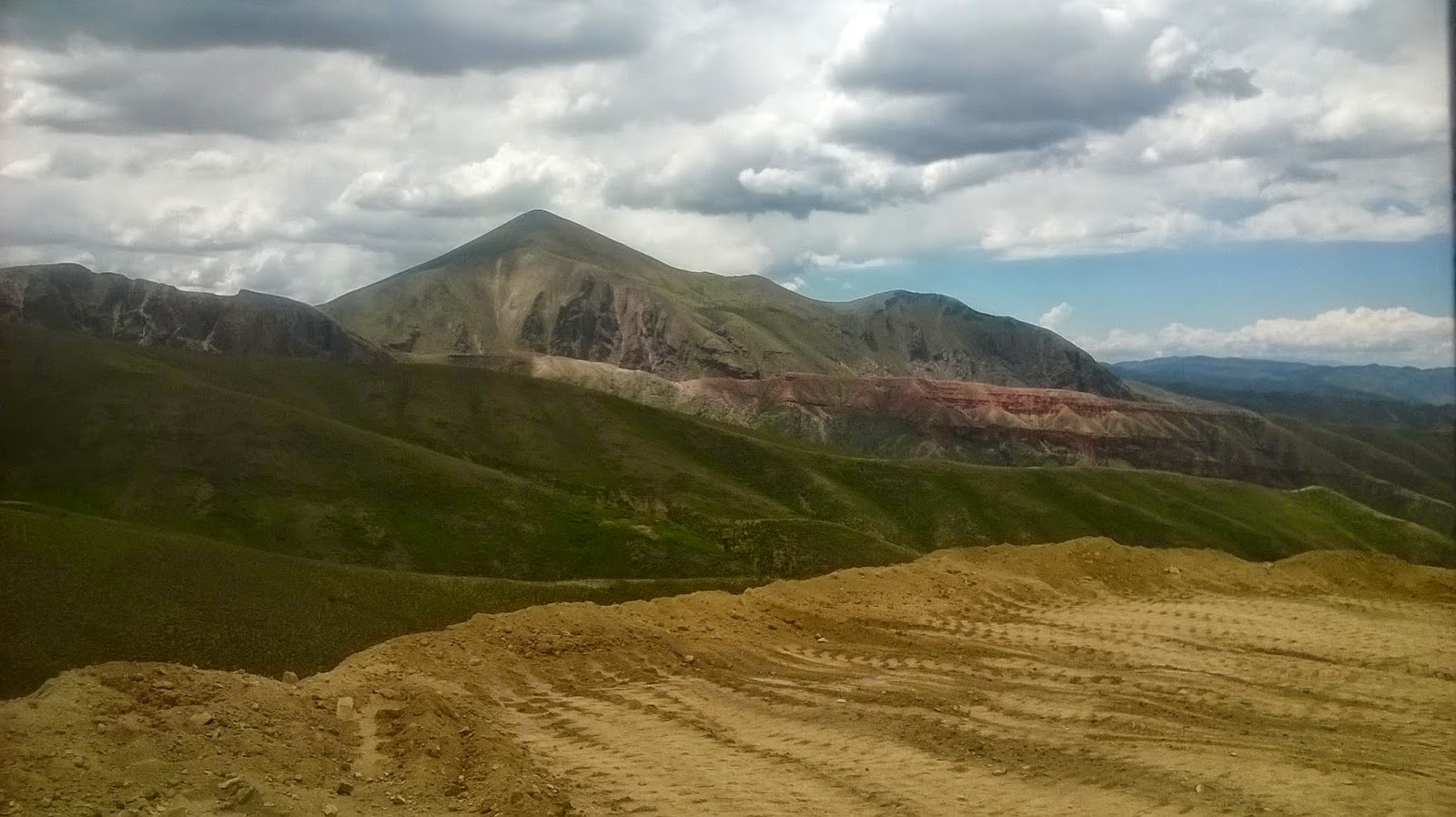
As we made our way out of the village through a valley I realised why it was preferable to take this journey in daylight. The road meanders up and down mountains and through valleys. Needless to say my heart was pretty much in my throat the whole way, although the views when I dared to look out of the window were stunning. I suppose the advantage to taking the night bus would have been that I would be none the wiser, however with the bumpy road surface I doubt I’d have got much sleep.

We eventually hit a proper main road and I could hear that every time the driver went to change gear it was taking a while for it to engage properly, which I guess wasn't surprising after the route we’d just taken.
 
We pulled into Tupiza, the stop before Villazon and everyone got off, I stayed on the bus as the engine was still running. The steward got on and explained I needed to change for a bus to Villazon, so much for it being direct. He helped me with my bag and showed me the bus I needed to take. It is what is known here as a micro, kind of like a minibus, my big rucksack was tied on the roof rack and I ended up squeezed in the back.
 
I arrived in Villazon at 3.30pm and as soon as I got off the bus I was accosted by people wanting to sell me onward bus tickets from La Quiaca. As I needed a ticket and the price was cheaper than if I bought from La Quiaca I went to the office.
 
I had a scary moment when the guy said he needed to take my passport next door to finalise the ticket as his computer wasn’t working. I got a bit shrill and insisted I follow him especially as I had already handed over the cash. Thankfully it was all fine, but I’d rather overreact in this situation especially when my passport is involved.

From there it was a five minute walk to the border. I crossed a bridge then joined a queue for the Bolivian window first to get stamped out. I then moved along to the Argentinian window to get stamped back in. After this there is a bag search area, but the guy searching my bag was very lack lustre so it took all of two minutes.
 

From the La Quiaca border post it is a good 15/20 minute walk to the bus station. As far as border towns go it isn’t too intimidating but there isn’t much there. There also isn’t a lot in the bus station either and I had a lovely six hour wait until my bus at midnight.
 
I had enough Argentinian pesos on me to get some food and just down the side of the bus station were some food stalls where I got a couple of slices of pizza for 12 pesos. I had some teabags on me and was also able to get a cup of boiling water from one of the kiosks for one peso.

The wait was long and cold so I amused myself by people watching and there seemed to be a lot of people who must have been in Bolivia on stock buying trips as the woman next to me was re-boxing a load of toys and sweets.
 
Finally, midnight came and the bus arrived. I travelled with a company called Balut. The bus was comfy enough but it was freezing cold. Ended up sat next to an old Argentinian man from Jujuy and we had a bit of a chat, although my understanding was hampered somewhat because he had hardly any teeth and a big wad of coca leaves stuffed in the side of his cheek.

Due to the fact I’d been up since 5am I was suitably tired and fell into quite a deep sleep, so deep I didn’t realise we’d stopped or that the majority of the other passengers had got off the bus until I was woken by a checkpoint guard wanting to search my bags at 4am. I remembered reading that buses coming from La Quiaca are often routinely stopped at checkpoints for searching in case of contraband being brought over from Bolivia. At least being asleep meant I didn't have to get off the bus.

At 6am we got stopped again and still in the haze of sleep I was asked by another checkpoint guard for my passport. Unlike other times when it’s been a quick check and all done with he asked several questions such as where I had come from where I was going and when I’d been in Chile. Seemingly satisfied he moved on. We finally arrived in Salta at 8am.

Friday, 24 April 2015

Six people, three days, a 4x4 and a lot of salt

In San Pedro de Atacama I decided to take a three day 4x4 trip finishing in Uyuni, Bolivia. Emily, Kris, Korbin and Tas, who I'd met on the Pachamama trip were also planning to do the same so we decided to go together.

We went to several agencies around the town to get quotes. Most agencies all offer the same trip, but with this sort of thing going cheap probably isn't best. Eventually we settled on a company called Atacama Mistica as it was mid-priced at 85,000 pesos.

The only problem was that due to the weather the usual route to the border wasn't open, which would mean we'd miss first day's activities in order to drive to the crossing further up. We decided to wait for a couple of days until the situation changed by which time we realised there were elections in Bolivia and this means no one can work as they should be voting. So it was we opted for a departure the following day to minimise disruption.

We were given a list of things to bring for the trip including 200 Bolivianos, snacks, five litres of water each and toilet roll. As the majority of this journey would be at altitude I also took along various coca products to help with any symptoms including tea and sweets. San Pedro de Atacama is already 2,400m above sea level so we had, had time to acclimatise a bit, however on the first day of the trip we would be going up to 4,900m. 

At the Bolivian border
We were picked up at our hostel at 8.30am where we were taken to the Chilean border point in the town to get stamped out of the country. It was then a 40 minute drive out of town up into the mountains to the Bolivian border. It has to be one of the most relaxed border crossings I have done. Just an official sat in a small brick building stamping passports, no bag checks or anything.

It was all quite surreal and a little chaotic as we were on top of this mountain with snow all around us and lots of other tourists all trying to find their relevant jeep and driver. 

After the border formalities we were taken to the only other building on the mountain for breakfast. Our expectations had been low but quite a spread had been laid on - rolls, biscuits, coca tea, yogurt and apples.

We were then introduced to our driver, Nelson, who loaded our luggage on top of the 4x4 - a Toyota Landcruiser. We were also joined by a German guy called Mathis. Needless to say it was quite cosy in the vehicle but being short I didn't find legroom that much of an issue.

From the border we entered the national park, which cost 150 Bolivianos and our first stops were a couple of lagunas - Laguna Blanca (White Lagoon) and Laguna Verde (Green Lagoon) - both were incredible.   

From there we went to a hot springs, where it was possible to have a dip, although I decided not to as the pool was very busy. We then saw some geysers and I was shocked at how close we were able to get to them. 

We stopped at the Refugio where we would spend the night. It was very basic, no showers just basins and three toilets but it would do the job for one night. All six of us were in the same room, which actually had a bit of a hospital ward feel about it.

The beds were adorned with lots of blankets all with interesting designs ranging from horses and tigers to puppies. We had lunch, which consisted of hot dogs, mashed potato, cucumber and tomato. It was surprisingly nice despite being packet mix mash. 

After eating we went to the final laguna of the day - Laguna Rojo (Red Lagoon) where we saw flamingos it was amazing and the lagoon was really other-worldly.

Back to the Refugio I was feeling the affects of the altitude (4,300m) and had a slight headache. So I had a quick siesta before supper, which was a vegetable soup followed by spaghetti and a tomato sauce.

As soon as the sun set it got really chilly in the Refugio and as we had to be up early the following day we were all in bed by 8.30pm. For fear of being really cold in the night I pinched three blankets off the empty bed next to me making a grand total of seven on my bed - needless to say I had a perfectly toasty night.

The next morning after a breakfast of pancakes, dulce de leche and coca tea we made our way to the first stop of the day the stone tree. The stone tree was exactly that, a rock formation in the shape of a tree. Around the tree were loads of other volcanic rocks in various formations and it was really intriguing as to how some had become the shape they were.

We visited a couple of other lagunas, Honda and Chearcota before stopping for lunch at Laguna Hedionda. It was a lovely day and  Nelson set lunch up for us on one of the  picnic tables outside - rice, tuna, tomato, cucumber and some lollipops for dessert.

After this we stopped at a point where we could see Ollague volcano. We ended up there a bit longer than planned due to an issue with our 4x4, which seemed to involve a lot of the other drivers standing round looking at the car and giving their opinions. After about 40 minutes the issue was resolved and we were on our way again.

We had a brief stop in the village of San Juan before reaching the salt hotel on the edge of the salt flat where we would stay the night. In comparison to the Refugio it was positively luxurious. The walls of the hotel were made from salt bricks and the floor was covered in a kind of salt gravel. We were also able to take advantage of the one hot shower there, which had a time limit of 8 minutes per person.  

Dinner was chicken legs with chips and fried plantain we also had a bottle of vino tinto to share.

The next day we were up at 5am ready to leave at 5.30am to see the sunrise over the salt flat. It was quite eerie driving over the salt at that time of day as it all looked very blue, we stopped at a point where we could get out and watch the sun come up. It wasn't the best sunrise ever as there were clouds but it was still good to watch.

We then stopped at an Fisher Island on the salt flat where we had the chance to wander round and get a different perspective. I was quite out of breath at one point as I forgot about the altitude and walked too fast up a hill.

From the island we continued across the salt flat, for a while I found it difficult to process that it was salt because it is white you automatically relate it to ice. However I can confirm it is definitely salt as at one of the stops I did have to try some just to make sure. I also found it impressive that the drivers know which way they are going as everything looks the same to me and there are no definite tracks.

We had time to stop to take the standard perspective bending shots, that the salt flat is famous for.   

We then stopped at a statue made from salt commemorating the Dakar rally. From there we went to a salt lake, the water was so clear it was like a mirror.

Then we had for lunch in the small town of Colchani before visiting my second train cemetery this trip. The engines were a lot older than the ones at Baquedano and there was even a swing constructed between two of the engines. After this we reached Uyuni our final destination.

It is difficult to put into words how utterly breath taking this trip was. Everyday we saw something better than the last, it has definitely been one of the main highlights of my trip so far.


Tuesday, 14 April 2015

Pachamama By Bus - Part 2

After returning from Castro I had one day in Santiago to get ready for the next leg of my trip with Pachamama By Bus - this time heading north. So it probably wasn't the wisest of ideas to go out the night before until the wee hours - oh well at least I was spending most of the next day on a bus.

My idea had been to take the bus to San Pedro de Atacama where I would then hop off and cross to Salta in Argentina before heading to Bolivia. However, as you will read below the weather had other ideas. My ticket for 6 days travel cost 148,000 pesos. 

There were five of us leaving from Santiago on the bus and unlike the southern one we were all of a similar age. Emily had booked to do this route too so we were reunited again for the fourth time. The other people on the bus were Meike from Germany and Tas and Kris, a couple from London. Kris is also the first Polish person I have met on my travels.

We were told we would meet our guide Catalina in La Serena, which was the last stop of the day. So it was just us and our driver Pedro until then. We stopped for lunch in Pichidangui, where I had my first cheese and shrimp empanada, it was a fried one so the cheese inside was like lava!

In La Serena we met Catalina and like Francisco the guide on the previous trip it was also her first tour. La Serena is well known for being a main producer of papaya products and we stopped in a market where you could buy pretty much anything made of papaya. I ended up buying some sweets, which reminded me a bit of fruit jelly sweets but not so artificial tasting. The city also has 29 churches so it isn't surprising that we saw a few while we wandered around.

Our accommodation for the night was in Hostel Nomade a wonderful old building, which at one time used to be the French consulate. Inside it had high ceilings and lots of period features. On arrival we were also welcomed with a shot of cactus Pasco it was really nice and didn't taste alcoholic at all.

The next day after being woken periodically by the cockerel in the garden from 4am onwards we headed to Bahia Inglesa stopping at Punta de Choros on the way.

In Punta de Choros we were able to take a boat trip to the National Reserve Penguino de Humboldt. We were given lifejackets to wear and I'm pretty sure mine wouldn't have been of much benefit had I gone overboard as it was far too big.

The boat trip took us alongside some of the islands in the reserve where we got to see pelicans, Peruvian boobys and Humboldt penguins. We were also lucky enough to spot a couple of sea otters and several bottlenose dolphins.
 
We were able to get off the boat on Isla Damas. The beach on the island was amazing and I don't think I've ever seen water so clear, unfortunately we weren't allowed to go swimming. The boat tour cost 10,000 pesos and entry to Isla Damas cost an additional 2,500 pesos.

We we were staying two nights in Bahia Inglesa and the following day the weather was good so we headed to the beach, which was a stones throw from the cabin we were staying in. However, the gate to the beach was locked and the only way we could access it was to crawl under a gap in the fence, which thankfully wasn't that well maintained. 

After walking up the beach and commenting that the sea didn't look that inviting the wind must have changed and brought with it a smell I have never smelt on a beach and hope I never have the misfortune of smelling again. It was akin to raw sewage.

Further up the beach we saw signs saying you couldn't swim - don't know who would want to with that smell lingering in the air. Thankfully it turned out we were walking in the wrong direction and the nicer beach was further towards the town. By the time we got there we only had 30 minutes before we had to head back and go to the fishing town of Copiapo for lunch.

In Copiapo we visited the fish market, which is where we had lunch and I had congrio again. At the back of the fish market in the dock area were loads of pelicans, gulls and sea lions, which seem to hang around waiting for scraps of fish from the market. 

Later that evening we had a BBQ and met a young German couple who would be hopping back on the bus the next day. The BBQ was really good although we had way too much food and a lot of steak ended up being leftover.

The next day we were heading to Antofagasta and would cross the driest part of the Atacama desert. During the night there was a massive thunder storm, but being on the coast we didn't really think much of it. However, the rain lingered and I can now say that I am one of the few people to ever see it rain in the Atacama desert. Thankfully it eased off enough for the two stops we made at the old cemetery of Oficina Chile, which was where there used to be a nitrate mine. It was quite weird and I felt a bit funny walking around the graves. After that we stopped at the Mano del Desertio (hand of the desert).

In Antofagasta we went straight to see La Portrada, which is a rock formation in the sea shaped like an arch. I was particularly fascinated by the colours of the cliffs here.

After spending a rainy night in Antofagasta we were given the bad news that due to the condition of the roads and flooding in places we may not make it to San Pedro de Atacama. This was particularly gutting as this day was billed as being one of the best on the trip. Needless to say spirits were a bit low, however we did get to stop at the train cemetery in Baquedano and had fun messing around on the old carriages there. However, I would recommend not wearing flip flops as there was a lot of broken glass along with excrement possibly human and animal in between the carriages. 

After leaving Baquedano we crossed the Tropic of Capricorn and reached Calama, which is the biggest town before San Pedro. While we were there we got news that the road was ok and we would get to San Pedro as planned. When we arrived the usually dry and dusty roads had turned to mud the main street looked like a scene from Glastonbury festival when it rains!

We stayed at Hostal las Kanas and in the reception we saw on the news that a state of emergency had been declared in Antofagasta, where we had been just hours before, due to the flooding. Copiapo was also underwater another place we had been just a couple of days ago. It was quite scary as we'd had such a narrow escape. Of course it took three days before the floods even made the news in the UK due to Jeremy Clarkson and Zayn Malik dominating the headlines.

As the areas affected by the flooding aren't geared for rain, a bit like in the UK when we get snow, many of the major roads had been cut off due to mudslides. This included the main route back to Santiago, the border area with Argentina and also the Bolivian border in the mountains above San Pedro.

Rather than spending just a couple of nights in San Pedro we had five, for me it wasn't too much of a problem as I'm not on a tight schedule but for some of the passengers it was a bit of an agonising wait to hear if they would be able to leave to make connections elsewhere.

San Pedro is probably one of the more touristy towns I've visited on my trip, mainly because it has become a good launching point for people wanting to get to Uyuni in Bolivia via the salt flats, but it is quaint all the same.

Most of the buildings in the town are made from adobe mud, which are sometimes whitewashed, in comparison to places I've been to up until now I suppose it looked a lot more like you'd expect a town in South America to look.

The main street is full of tour agencies and shops selling alpaca wool jumpers, textiles etc. If you aren't going on to Bolivia or Peru it is worth getting stuff like that here but if like me you are then wait as it is all available there and at a much cheaper price.

While we were in San Pedro we went to the Valle de la Luna (Moon Valley), which has many rock formations akin to the surface of the moon and the Mars Rover was actually tested here due to the conditions being similar. We went just around sunset and at our last stop we were able to walk to then top of a huge sand dune and the views were incredible, some might say out of this world (sorry had to be done).

It was during my stay in San Pedro that I decided to reverse what I originally intended to do and go on to Uyuni followed by Salta.              

Monday, 6 April 2015

Chilling in Chiloe


After almost a week of early starts I was looking forward to taking it easy on Chiloe, which is an island in the Pacific just off the coast of Chile. As I only had a limited amount of time I chose to stay in Castro, the capital of the island.
 
I used the bus company Cruz del Sur to make the journey from Puerto Varas to Castro. The company has several departures each day and I caught the 9am bus. The trip was quite pleasant and the ferry crossing was so smooth it took me a while to realise we were even moving!
 
About four miles out of Castro we got stuck in a big traffic jam. Assuming there had been an accident I took a nap and also caught up with some journal entries.
 
After about 1.5 hours we had moved but not a lot. I checked my GPS and we were about 1.5 miles from Castro. I could see the town in distance along with some smoke. A lot of other passengers were getting off and walking so I decided to join them and got my luggage.
 
As I approached the town the road had been blocked off by the police and I could see a tanker in the distance along with plumes of black smoke. People seemed to just be walking straight through, which puzzled me as at this point as I thought the tanker was on fire. I tentatively walked past the road block expecting to be stopped but wasn't.
 
When I got round the other side of the tanker I realised it was a protest of some sort as there were lorries blocking traffic in both directions and a big pile of burning tyres in the middle. The crowd seemed in good spirits and appeared to be quite amused by me walking through with all my luggage.

Chiloe is well-known for its palafitos, which are wooden houses on stilts over the water and the ones I saw in Castro were also really colourful. stayed at Palafito Sur, which is in a traditional palafito common on the island.

I stayed at Palafito Sur, the hostel was nice although the four bed dorm I stayed in was a little bit of a squeeze when full of people and bags. As there was no traffic getting out of Castro the hostel was very full as people who had been due to leave had to stay another night. 

The next day the strike was over so I took a wander round the town, first walking out to Peninsula Ten Ten, which has good views across the water to Castro. Then I walked back into Castro and discovered the fish and artisan market where I bought myself some gloves.
 
I had been warned that it rains a lot on Chiloe but I was really lucky with the weather and had sunshine and blue skies. In the centre of Castro there is the Iglesia San Francisco de Castro, which looks very Disney-esque as it is painted yellow with purple turrets. 
 
In general Castro really reminded me of a small cornish fishing town and at times I had to keep reminding myself I was in Chile because the landscape was very similar to England.

During my stay I bumped into James and Vicky, an Australian couple I met on the Pachamama tour, they invited me to dinner with them that evening at a restaurant just a few doors down from my hostel. I had ceviche for the first time this trip and it was really tasty. There was so much of it I was rather full afterwards.

I left Chiloe the next day to make my way back to Santiago in time to catch the Pachamama bus heading north. I took the Cruz del Sur bus back to Puerto Vargas and even managed to get myself a discounted ticket for a full cama seat with the company Tur Bus for my onward journey back to Santiago. Needless to say I slept really well and unlike many of the Argentinian buses I’ve taken it was pleasantly warm rather than air con cold.

I would definitely like to return to Chiloe to explore more of the island as there is much more to see there.


Pachamama By Bus - Part 1


While I was in Santiago I looked up a company I’d read about called Pachamama By Bus, a long distance hop on-hop off service specifically tailored to independent travellers. The company has a Northern route and a Southern route and I planned to do both starting with the South, which is detailed in this post.

The company is based at the Princesa Insolenta hostel, which is where I was staying in Santiago so it was easy for me to get more info and pay for my five day ticket, which cost 110,000 pesos.  
On the first day of the tour there were eight of us travelling from Santiago and after picking up two couples and a guy, who were all in their sixties, I was hoping that the final two passengers might be a bit younger.

I got a shock when who should get on the bus but Emily, a girl I’d shared a dorm with when I first arrived in Buenos Aires and hadn’t seen since Puerto Iguazu. The final passenger was Lindsey another solo female traveller from Canada. Our guide for the trip was Francisco. 

On the first day we headed to the coastal town of Pichilemu, which is known for being a great place to surf. When we arrived there was an option to have a surfing lesson for 10,000 pesos. Having lived on the coast of England for the majority of my life I have never surfed, but something about trying it in Chile appealed – mainly that the sea would be warmer. What I hadn’t considered was that the lesson would be in Spanish.

Wetsuit on I waited for my instructor and part of me hoped for a handsome, muscular Chilean, however when he showed up he was more salty sea dog than the Adonis I’d been hoping for.
After introducing ourselves we headed to the beach where he told me we had to warm up by going for a run. I’m sure we must have looked fairly ridiculous running along a sandy beach on a hot day in full wetsuits.

After the run it was time to practice on the beach what I’d have to do in the water. It was surprisingly easy to pick up what he was asking me to do in Spanish and I think I lost count of the amount of times I said ‘Si’ to show I’d understood. He would occasionally bark ‘flat foot’ at me as I had a tendency to arch my front facing foot.
Once he was satisfied I’d got the action down we headed for the water, perhaps a bit sooner than I’d anticipated. In the water the first wave I caught I managed to just about stand up before toppling over, however after a few more tries I actually managed to stay stood up and gained a thumbs up from my teacher. Towards the end of the lesson we tried some bigger waves and I managed to stand up again for the last wave of the session.

That night we had a BBQ, which was a good way to get to know the other people in the group and everyone was very friendly. During the BBQ Emily and I attempted to cook oven chips in a pan on the grill – it wasn’t a total disaster but if we’d had oil we may have been more successful.
The next day was a long driving day and after an early start we travelled the 466 miles to Pucon, which is where the Villarrica volcano is. It is one of the most active volcanoes in the world, so active in fact that just two weeks beforehand it had erupted causing the town to be evacuated. Thankfully it was only a small eruption so the town was open again when we arrived.

Villarrica volcano
Unfortunately it meant that I didn’t get the chance to walk up it, but I was told it would be possible to hike up Quetrupillan volcano instead, which is also higher than Villarrica. It took me a while to decide whether to do the hike because it involved having to leave at 6.30am. I was also told it was much more physically demanding than Villarrica, but as one of my main reasons for wanting to go to Pucon was to walk up a volcano I decided to do it. I booked the hike through Aguaventura for 40,000 pesos this included transport to the trail, a guide and equipment.
The next morning I headed to the agency where we had a quick briefing and were told the conditions looked good for the day. I also met the three other people doing the hike – they were all French – and our guide, who from the side looked like Peter Andre.

The start of the trail was about 40 minutes out of Pucon. The first part was through forest and I found the going slightly more difficult as I ended up behind the oldest member of our group 67-year-old Serge, who was walking with two ski poles and every time he walked through a narrow gap with dense foliage it would catch on the poles and flick back at me. When we stopped for a break I took the opportunity to make sure I wasn’t behind him again.
After about two hours we reached the end of the forest and the start of the main ascent. The terrain was probably some of the hardest I’ve encountered as it was all loose dirt and sand. As we climbed further up the views were amazing and we also had great view towards Villarrica volcano too. By this point the sun was out and it was hot.

The final 30 minutes to the summit were excruciating, my calf muscles were so tight from all the uphill walking every step was painful. I was also pretty hungry but I found this helped me to keep going as I knew I’d be able to eat once I got to the top. As we reached the summit there were five condors circling above us – an awesome sight.

Once at the top we had a well-earned rest on the edge of the crater, which is now a glacier. I can now also say I’ve had a nap on a volcano as in the sunshine I just couldn’t help but close my eyes and drift off for a few minutes. We stayed at the summit for about two hours before making our descent.

What had taken us the best part of two hours to climb earlier took a mere 40 minutes to descend before reaching the halfway point. Another hour and we were back to the start where we celebrated with a well-deserved beer. I didn’t dare take my boots of as I knew I’d never get them back on again.
Back at the Aguaventura office I had a quick turnaround before being picked up by Francisco and the other passengers to go to Los Pozones hot springs, which was exactly what I needed after a day of hiking and my feet certainly appreciated it. The springs were in open air natural rock pools and as it was a clear night we could see loads of stars too. It’s also the first time I’ve properly noticed that the moon is the wrong way round here.

Next day we drove through the lake district to Valdivia, the countryside in this part of Chile really reminded me of England -very weird. We stopped at a market in Conaripe for lunch where I tried a humita, which is mashed maize steamed in the leaves of the corn, it was really nice and filling.

Valdivia is located between the rivers Calle Calle, Cruces and Valdivia. It is also home to several sea lions, which we saw on pontoons really close to the path. Our accommodation didn’t have a kitchen so Emily and I headed out to eat. I’m not sure if it was because it was Sunday but there only seemed to be one restaurant open, but it was nice enough and we shared some grilled congrio - conger eel.

From Valdivia we headed to Puerto Varas, which is where I’d be hopping off the bus and going on to the island of Chiloe. We stopped in Puerto Montt on the way, which is the main departure point for people heading to the far south of Chile.
We had a great lunch in a small restaurant near the fish market. The restaurant was decked out with two long tables and I don’t think more than 15 people would have squeezed in there. I had a dish called curanto, which consisted of two pieces of salmon covered in melted cheese and topped with a sausage. Sounds rather strange but it was really nice.

In Puerto Montt three people hopped off and as two had previously hopped off in Pucon it just left myself, Emily and Lindsey going on to Puerto Varas.
Puerto Varas is a picturesque small town on the shores of Lake Llanquihue and it was where I bid my farewell to Pachamama By Bus. Francisco had been a great guide and was really knowledgeable about each place.

I would recommend using the company if you are short on time and the option to hop off means you can spend longer in some places if you wish. For me it was a welcome break to have someone else do all the organising.


Friday, 20 March 2015

Seduced by Santiago

 
From Mendoza it was time for me to head to Santiago, Chile. I'd heard that the bus journey across the Andes was particularly spectacular but there could be long delays at the border crossing. I decided to take the first bus out of Mendoza at 7.30am so I would be able to appreciate the scenery in daylight and hopefully not get too held up at the border.
 
It was a 6 hour journey and I chose to travel with Andesmar again as I know what to expect with them.

We reached the border crossing after about 3 hours and I had been glued to the window the whole way, the views were spectacular as we wound our way through the mountains. I was also intrigued by a railway track that ran parallel to the road and hoped it was no longer in action due to it being in various states of disrepair.
 
The border crossing took about 40 minutes and I obviously hadn't learnt my lesson after the carrot incident as I remembered halfway through the journey that I had spices and a tin of tuna in my bag. I will blame the early start for that one! I ticked the 'something to declare' box on my form as I really didn't want to risk being fined. However, I needn't have worried as nothing was said and my big rucksack didn't get singled out for searching after having the once over from the sniffer dog and x-ray - phew.

I arrived in Santiago pretty much on time and got a taxi to the Princesa Insolente Hostel in Barrio Brasil. The hostel is pretty funky and I loved the décor.

When I went out to the supermarket my first impressions weren't great - a few seedy looking bars and sex shops (the first ones I've seen on my trip). However, after exploring the neighbourhood further during my stay I came to like its quirks. Nearly every building is covered in graffiti of some sort and most of it is really good. I like the mix of big old crumbling mansions in among the more modern buildings and just watching the day to day goings on of the locals. It is the kind of neighbourhood I imagine back home would end up becoming overrun with hipsters given half the chance.
 
I had five days in Santiago, which is more than enough time to take in the main sights. 

First stop was the Mueso de la Memoria, which is all about Chile during the Pinochet years and was within walking distance from my hostel. I had read a bit about the history prior to coming to here, but the museum really brought home what the reality was like for many Chileans during that time.

Entry was free and it's possible to get an audio guide for 2,000 pesos - I would recommend getting this as pretty much everything is in Spanish. I would also suggest making sure you have low denomination notes as they didn't have enough change for a 10,000 peso note when I went. This meant I got a much less detailed English booklet for free. Not having an audio guide did give me an opportunity to practice my Spanish reading and I found I was able to get the main gist of most of the exhibits - if only my speaking was as good! 

After having spent a good part of the day in the museum I headed to Parque Quinta Normal, which is just opposite, for some fresh air. As it was a Sunday it was a hive of activity, families having picnics, children racing round on bikes, young couples kissing, ice cream and drink vendors peddling their wares and even some breakdancing.

It was probably the noisiest park I have ever been in and I enjoyed just aimlessly walking and people watching. I went back to the park later in the week and it was pretty dead so I would recommend going at a weekend if you can.
 

Next day I took the metro from Republica to the centre of Santiago and had a wander round. I started by going up Cerro Santa Lucia, which among other things used to be a convent. There were Italian style fountains, a chapel and even a Japanese garden. Watch out for the sprinklers on your way to the top though, but as it was a really hot day I was glad to cool off. From there I strolled past Palacio de Bella Artes, which is set in the Parque Forestal, towards the Plaza de Armas. 

I then walked down Paseo Huerfanos and Paseo Ahumada, which is a pedestrian shopping street and as it is near the main business district it was full of people in suits at the time I passed through. 

Hot dogs or completos are a popular snack in Chile and I passed several places serving them, I don't normally eat them at home but as I was peckish I didn't need much persuading. I opted for an Americano, which came topped with salsa verde, tomatoes and mayo.

My last stop was the presidential palace, Palacio de la Moneda, also the site of the coup in 1973.

The following day I visited Cerro San Cristobal. I took the funicular, 2,000 pesos return, from Estacion Central at the end of Pio Nono to Estacion Cumbre. Then it was a short walk up to statue of the Virgin Mary, which stands on top of the hill overlooking the city. The views were pretty good and would have been even better if it weren't for the smog shrouding everything in the distance.
Back down the hill I wandered around La Vega Fruit Market, Central Market and Tirso de Molina Market. Chile prides itself on it's fresh produce especially fruit and vegetables and I enjoyed walking around La Vega seeing what was on offer - including loads of dried fruit.
I finished off by going to the oldest dive bar in Santiago - La Piojera (The Fleahouse), which is akin to a ruin pub in Budapest. The bar is famous for a drink called the terremoto - earthquake (sweet white wine, grenadine, bitters and ice cream) it was actually quite nice but pretty lethal, another and I'd have probably been on the floor!

On my final day I went to La Chascona, which was poet Pablo Neruda's Santiago home. Entry cost 5,000 pesos and came with an audio guide. Neruda designed the house to be shiplike so it was pretty unusual - I actually wouldn't mind living there. I loved all the various pieces of art and ornaments in the different rooms.

I wasn't that familiar with Neruda's work before going to the house but his poetry is beautiful and I will definitely be reading more when I return to the UK.

I had lunch at Galindo a restaurant serving traditional Chilean dishes in the Bellavista neighbourhood. I tried Pastel de Choco, which is a bit like a pie made with mashed maize and filled with beef, chicken, olives and an egg. I also had Porotos Granados, a stew made with white beans and mashed maize. The one I had also included bits of squash and a sausage. Both were really yummy but filling so I ended up taking the leftovers with me!


Despite being surprisingly taken with this smoggy, colourful, vibrant and at times shabby city, after five days I was ready to head south again to some smaller towns before it starts getting too cold. 

Wednesday, 11 March 2015

Red, red wine...

After leaving El Bolson my next port of call was the city of Mendoza in the heart of Argentina's wine country and home to malbec.

I used Andesmar again for the 21 hour journey and as El Bolson doesn't have a main bus terminal the coaches stop at their main company office in the town, these are all quite close to one another so fairly easy to locate.

First surprise of the journey was that the bus was actually early. After lunch, which comprised of the now standard ham and cheese roll with mayo, was a game of bus bingo! A great way for me to practice my numbers, I didn't win but the woman behind me did and she got a bottle of wine.

Dinner consisted of the most carbs I have ever seen as part of a meal - bread roll, slice of focaccia, muffin, slice of cheese and ham followed by a chicken cutlet and mashed potatoes! Thankfully I still had some tomato and chickpea stew leftover so supplemented my mash with this just to give it some colour! 

The coach arrived in Mendoza on time too - another first. I had booked to stay at Hostel Mora and it was a fairly straightforward 10/15minute walk from the bus station. My main reason for choosing this particular hostel was that it offered a free wine hour every night, secondly there were pancakes for breakfast. 

I was in Mendoza for four days and spent the first two exploring. As far as cities go it isn't a sprawling metropolis so it was fairly easy to navigate and the centre is concentrated around Plaza Independencia. There are four further plazas around Independencia, which are equi-distant from one another - Plaza Italia, Plaza Chile, Plaza San Martin and Plaza Espana. My favourite was Plaza Espana because I liked the tiled seats and fountain.

I also wandered out to Parque Central, which was about a 20 minute walk from Independencia down Avenida Mitre. I took some food with me from the vegetarian (yes, vegetarian) take away round the corner from my hostel. There were actually two veggie places in the vicinity - I thought the fact there was one was pretty awesome but two! The park was pleasant with plenty of grassy areas to sit and it was a nice place to while away some time.

The next night the hostel was organising an asado (Argentinian bbq) for 120 pesos and as I had yet to experience this particular part of Argentinan culture I signed up - unfortunately it was cancelled due to there not being enough interest. I was particularly disappointed especially as I'd eaten hardly anything all day in preparation.

The following day one of my fellow dorm mates told me about a buffet place she had been to during her last trip to Mendoza, which did lots of meat dishes and had a built in asado. At 140 pesos all you can eat how could I say no especially after the disappointment of the previous night! The place opened at 8.30pm and we were the first people in there, which was good as by 9pm it was heaving. 

The food was a-mazing, now I'm not the biggest meat eater but the dishes I tried were delicious. The slow cooked lamb in a tomato based sauce was to die for. Needless to say I went back to the hostel that night painfully full.

  
As I was in wine country it would have been rude not to at least visit some wineries during my stay. I booked to do a whole day bike and wine tour for 600 pesos on my last day. I would get to visit 3 wineries and have lunch at one. I was a little apprehensive about how wise it would be to ride a bike after a day of wine drinking but I thought it would be more fun than going in a bus. 

However, the morning of the tour the receptionist told me that unfortunately due to issues with the transport supposed to take us to the bikes the company had to cancel the tour. I was pretty gutted to say the least especially after the asado got cancelled earlier in the week - things didn't seem to be going my way. As it was my last day I couldn't try and book for another day either.

All was not lost though and I was able to book on a half day normal tour instead visiting two wineries and an olive oil producer.

The first winery was called Vistandes and was quite a modern set up. We got told about the wine making process then came the tasting. First up was a white wine (I forget what it was) but despite its fruity smell it was too dry for my taste. The second was a malbec but again I wasn't that blown away by it.

Next up was Pasrai an extra virgin olive oil producer. Again the process of making olive oil was explained to us and afterwards we were able to sample several oils from plain to flavoured ones. My favourite was the garlic infused oil, didn't like it enough to warrant buying a bottle to carry around with me though.

Final stop was a small family run winery called Don Arturo. Unlike Vistandes the winery was actually more like what I imagined one to be like - whitewashed buildings, grapevines, barrels etc and it felt a lot more personal too.

We were able to try three different wines and I discovered I have a taste for cabernet sauvignon - so much so I even bought a bottle for 60 pesos. I also liked the second malbec we sampled, which was a reserve one, however it was a little more expensive so I stuck with the cabernet sauvignon.

When I got back to Mendoza I was anxious that I needed to exchange some money for Chilean pesos ready for the next day so I'd have enough to get to my hostel. There was also the Via Blanca de Las Reinas parade to kick off the wine harvest celebrations happening in the city.

Thankfully I managed to locate a cambio office that was still open as I couldn't be bothered to try and find someone to do a blue market exchange with due to it being a bit chaotic and I only wanted to change a small amount. 

Turning water into wine - a fountain in Mendoza
After exchanging my money I secured myself a front row spot for the parade among a couple of families. As it got closer to the start time it started getting a bit more crowded. I had sort of made friends with the man next to me and his young grandson as I kindly held their spot while they went and got drinks.

The parade consisted of floats from the various provinces in the Mendoza region. On these floats are the harvest queens from each province, who get judged until one is crowned the overall National Wine Harvest Queen. In between the floats were gauchos on horses, a tractor procession, brass bands etc.

During the parade a few things were thrown from the floats into the crowd, this started with a few sweets - nothing unusual there, then progressed to pens (inwardly I was thinking health and safety would never allow this in the UK - they could take someone's eye out). If I thought the frenzy of the people around me for the sweets was bad the pens were even worse. I did manage to inadvertently catch a key ring much to the amusement of those around me.

After the pens came grapes, plums and apples. I am fairly sure if someone took a photo of me while this was going on the look on my face would have been one of bemusement mixed with fear as chaos ensued around me. 

The atmosphere wasn't violent at all and everyone around me was laughing and smiling while at the same time being very competitive. I even saw some people with baskets on sticks to help them catch stuff - serious business. My fear was mostly from the fact I didn't much want to end up being hit full in the face by an apple! I did manage to get a peach, which landed at my feet.

As if this couldn't get worse the people on the final float were throwing melons - yes that's right melons! It was at this point I regretted standing quite so close as an apple in the face is one thing, but a melon that could do some serious damage. I needn't have worried because a stealthy teenager crossed the barrier and managed to catch the one headed my way.

All in all it was a really enjoyable evening and fitting for my last night in Argentina. Also, as I missed out on some of the bigger Carnaval celebrations this definitely made up for it.